

Most of my bad shots start before I ever swing. I get lined up a few yards right of where I think I am aiming, the ball creeps forward in my stance, and by the back nine my back is tight enough that I start aiming with my eyes instead of my body. For years I tried to fix this by feel. I would lay a club on the ground and squint down it, or prop my phone against my golf bag and try to judge my setup from an angle that never looked right. One evening in March of 2025 I hit an entire large bucket of thin, weak shots that all started right of the flag. I changed my grip. I changed my stance width. Only on the last few balls did I look down and realize my feet were aimed right of the line the whole time. That is the day I stopped trusting my eyes. Then, in April 2025, I bought a set of Callaway Alignment Stix, and they have done more for my practice routine than any other piece of gear I own.
The back detail matters here, so I will be plain about it. I am 63, I play three times a week, and about four years ago I strained my lower back during a long range session. It never went back to how it was. It gets stiff in the morning, and it gets sore the evening after a round. When my setup is off, I make up for it by twisting my body to save the shot, and that is exactly how I re-aggravate the back. So alignment sticks are not a swing tip for me. They are a way to practice without spending the whole session fighting a crooked setup. I saw a physical therapist for six visits back when it happened, and if you have real back pain, that is where you should start, not with a training aid.
The Quick Verdict
The simplest training aid in my bag and the one I reach for nearly every range session. Two seasons in, they still lie perfectly straight, and my setup is the most repeatable part of my swing.
Amazon Check Today's Price →Stop guessing where you are aimed. Start every range session with a straight setup.
The Callaway Alignment Stix have been in my bag since April 2025. Here is what two seasons taught me, and why they still come out every week.
Amazon Check Today's Price on Amazon →How I've Used It
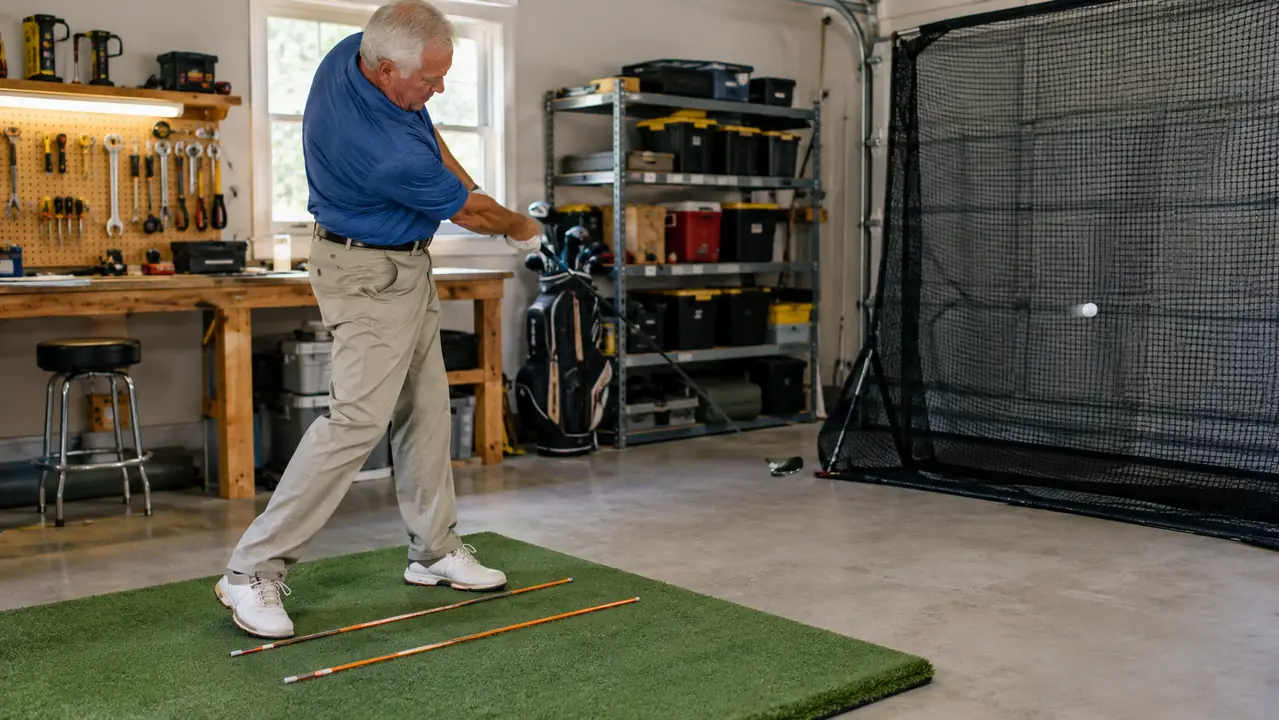
The Stix have lived in my golf bag since the day they arrived, which is more than I can say for most training aids. They collapse into short sections, so they slip into the bag next to the umbrella and I never have to think about them until I need them. I use them at the driving range one evening most weeks, and on the hitting mat in the garage over the winter. Last winter I hit into the net I already had, with the Stix laid out on the mat, and the garage sessions had the same structure as the range. They stay in the bag during a round and come out at the range, when I want to prove to myself that I am aimed where I think I am.
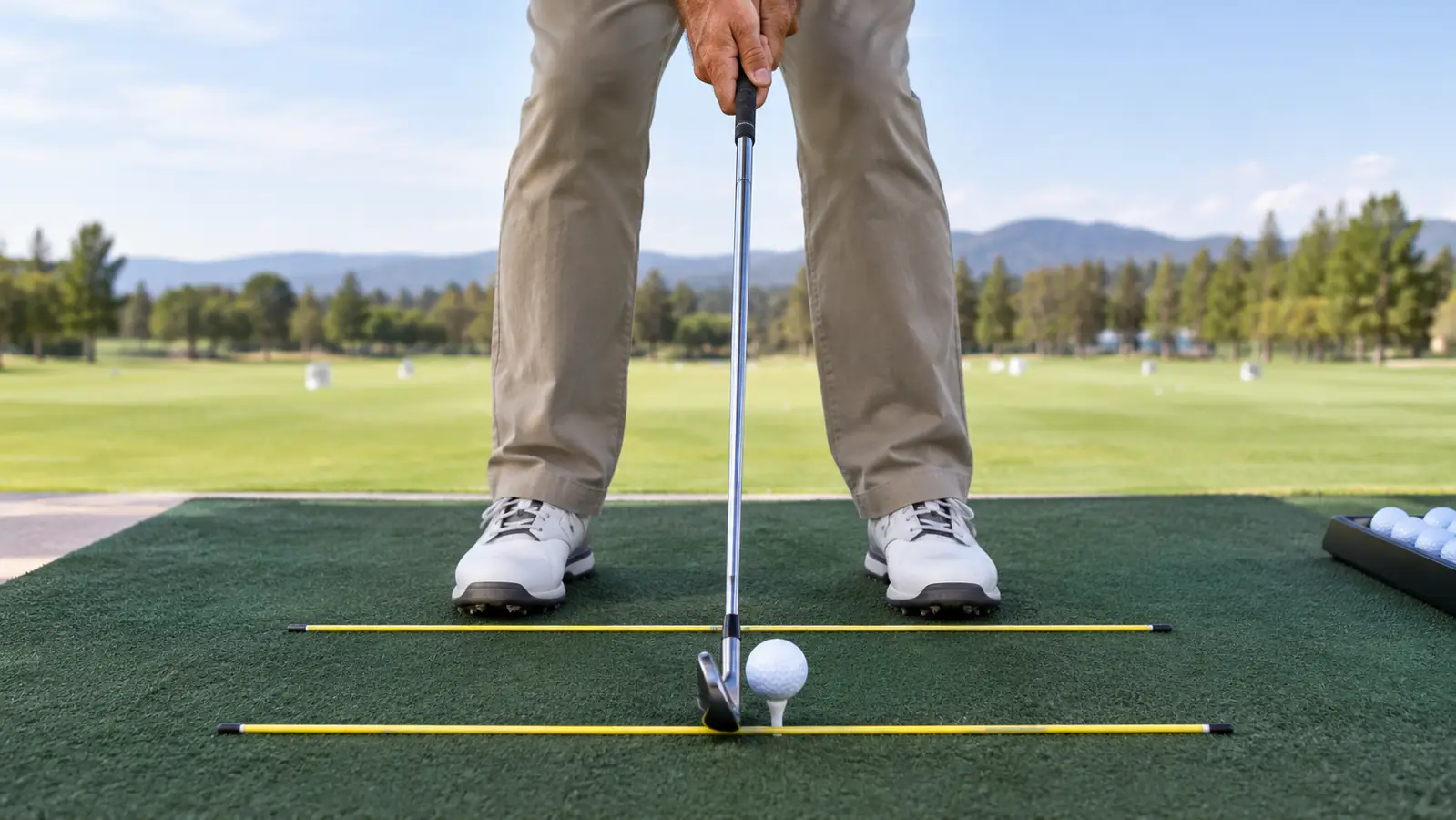
My routine is simple. I lay one stick along the target line just outside my toes, and I lay the second one along the ball line, about a club-length past the ball. I also use the second stick as a quick check on my ball position before I hit anything longer than a 7-iron. Then I hit a few wedges, a few mid-irons, and maybe the driver, checking after every shot that my feet are still parallel to the stick. The whole thing takes ten minutes, and it has become the part of my practice I trust the most.
I am finishing my second full season with them now. They have been rained on, stepped on, dropped on the cart path, and left in the trunk through a Cleveland July. They still snap together tight, and they still lie flat on the turf. For a guy who owns plenty of training aids that ended up in the garage, that alone is worth noting.
What the Stix Actually Do
The Callaway Alignment Stix are not complicated. You get two 48-inch sticks, bright yellow so you can see them at your feet without bending over, and they break down into short sections so they fit in the bag. One stick goes along the target line at your toes. The other goes along the ball line, or you can stand it up at an angle to check your swing plane. That is the whole product, and that is the point.
The job they do is simple, but it is the job I struggle with most. A crooked setup is why I hit a shot that starts where I aimed, which is not where the flag is. When I lay that stick down and step in, my feet line up on it, and suddenly the target line is right there in my peripheral vision. I stop aiming with my imagination.
The second stick is the part I did not expect to use as much. I tend to let the ball drift forward in my stance when I get tired. Laying the second stick at the ball position gives me a fixed reference, so I can check after every shot that I have not crept. The swing-plane trick, standing one stick up at an angle and swinging along it, is something I only pull out when I am working on a specific feel. It is useful, but the flat-on-the-ground version is what I use every week.
What a Full Season Taught Me
The honest headline from two seasons is this: the Stix did not fix my swing, and I did not expect them to. What they fixed was my practice. Before I had them, a range session was me hitting balls and hoping. Now it is me checking my setup on every shot, and the difference shows up on the course more than it does on the range.
The specific change I can point to is this. My misses used to start on a line I did not intend, and I would spend the rest of the round compensating. These days, when I miss, I usually miss where I was aimed, and that means the problem is in the swing, not in the setup. That sounds like a small thing, but it is the difference between fixing a problem and chasing a ghost. The clearest example came on a Thursday in August. I had been fighting a weak fade for a week, and at the range that evening I laid a stick down to check my feet. They were pointed a half club right of where I thought I was aimed. I squared up, hit the ball better than I had all month, and trusted my swing for the rest of the round.
Durability has been a pleasant surprise. The collapsible sections still fit together snugly, and the sticks have not warped or bent even though I have stepped on them more than once. The finish is scuffed where they meet the mat, but that is honest wear from use, not a defect. I have handled a friend's GoSports alignment sticks at the range, and they seemed perfectly serviceable. I cannot tell you how they hold up over a full season. I can only tell you that the Callaways have held up for me.
There is a quieter benefit too. Knowing my setup is honest lets me focus on the swing itself instead of wondering whether I was aimed wrong. Golf is hard enough without second-guessing the first part of every shot, and these sticks took that particular doubt out of my practice.
How They Fit Into My Back Routine
The reason I keep using these instead of letting them gather dust is the back. My lower back does not like being twisted, and a crooked setup makes me twist to compensate. When my alignment is honest, my swing stays within its limits, and I usually feel less stiff the evening after a round.
They are one piece of a routine, not the whole routine. On cold mornings I wear the Sparthos back brace over a thin undershirt, about one round in three. Most evenings after a round I spend ten minutes on the TriggerPoint foam roller on the living room rug, working my upper back, glutes, and hips. And before I play, I take a few swings with the Orange Whip in the backyard to get the tempo going. The Stix slot in at the start of practice, where they keep me from building bad habits into a tired body. Carol is the one who noticed I skipped my warm-up on days I felt fine, and she was right. The mornings I take those three minutes before I leave are the mornings I am not still loosening up on the second tee. The Stix serve the same purpose in a different way: a rushed setup is how I twist my back on the first swings of a session, and they slow me down before that happens.
If you are dealing with back trouble yourself, please hear me on this: a training aid is not treatment. I saw a physical therapist six times when I first hurt my back, and her advice is still the foundation of everything I do. The Stix do not fix backs. They stop me from making things worse with a lazy setup, and that is a real benefit. But it is not the same thing as medical care. If you are in real pain, see a professional.
The Tradeoffs
Nothing is perfect, and the Stix have their limits. The first is that they cannot see you. They show you where your feet are pointed, but they do not show you your posture, your grip, or whether your swing plane is on. For that I still use video, and honestly, video plus the Stix together is the combination that works for me.
The second limit is that they only help if you use them with intent. Laying two sticks on the ground and then ignoring them does nothing. The value comes from checking your alignment after every shot, which takes discipline. Some days I do not have that discipline, and on those days the sticks are just two yellow rods lying in the grass. I still remember a garage session last winter where I set the sticks up, hit forty balls into the net, and never once looked down at them. That hour taught me nothing. The sticks cannot make you pay attention; they can only show you the truth when you do. It is the same on the range, where the whole benefit lives in the checking, not in the laying down.
The third tradeoff is the one that applies to almost everything in golf. They are a tool, not a teacher. If you do not know what a good setup looks like, the Stix will not tell you. But if you already know, and you just need a way to check yourself, they are nearly perfect at that one job.
What I Liked
- Collapse into short sections, so they fit in the bag and go wherever you go
- Bright finish is easy to see at your feet without bending over, which matters when your back is stiff
- Built tough: two seasons of range mats, cart paths, and rain, and they still lie perfectly straight
- Two sticks cover both setup jobs, the target line at the toes and ball position or swing plane
- No skill required to use them, which is rare for a training aid
Where It Falls Short
- They only check your setup, they do not fix your swing
- The value depends on discipline, because you have to check after every shot
- Two sticks on the ground tell you nothing about posture, grip, or swing plane
- The collapsible joints are convenient, but they are the one part I could see wearing out after many more seasons
Eighteen months in, the finish is worn where they meet the mat, and the sticks themselves are still perfectly straight. That is the whole review in one sentence.
Who This Is For
Buy the Callaway Alignment Stix if your misses start with a crooked setup, which is most recreational golfers, whether they know it or not. They are for the player who lines up by feel and is tired of being a few yards off without knowing why. They are for the player whose ball position creeps when he gets tired. And they are for the player who, like me, needs practice to be efficient, because a stiff back does not allow for two hundred sloppy swings.
If that sounds like you, these are about the lowest-effort piece of practice equipment I own. Ten minutes a session, and the benefit carries straight to the course. My only advice is to put them somewhere you will see them, because a training aid only works if it is in the bag when you need it.
Who Should Skip It
Skip them if you already have a rock-solid setup and you know it. If video work has your alignment dialed and your only issue is the swing itself, the Stix will sit in your bag unused. Skip them if you expect a training aid to coach you, because these do not teach. And skip them if you are not willing to spend ten minutes checking yourself on the range, because a stick on the ground that you ignore is just a stick on the ground.
And if you are hoping for a quick fix that shows up overnight, these are not that either. What they give you is a way to practice well, and that takes longer and pays off longer. I would rather own a tool that makes me practice better for the next ten years than something that feels exciting for a week.
The bottom line after two seasons: they do one job, and they do it well
If your bad shots start before you swing, the Callaway Alignment Stix are the simplest fix I own. Check today's price on Amazon and see if they earn a spot in your bag.
Amazon Check Today's Price on Amazon →