

I bought the Orange Whip at the end of March 2026, mostly because my lower back had stopped letting me get away with rushing my swing. I am 63, I play to about a 16, and I golf three mornings a week at a public course outside Cleveland. Four years ago I strained my back after a long range session, and since then the stiff part of my day has usually been the first tee. A friend let me try his Orange Whip at the range one evening, and the thing felt odd in a way I could not stop thinking about. You cannot swing it fast without feeling clumsy. I ordered one that week, and seven months later it is the piece of gear I reach for most.
The Quick Verdict
The Orange Whip is the rare training aid that does not sit in the garage. It rewards a smooth tempo, punishes rushing, and doubles as a warm-up my back actually appreciates before a round.
Amazon Check Today's Price →The Orange Whip fixed my rushed tempo without me thinking about it
Seven months in, it is the first thing I grab on golf mornings. A few slow swings in the backyard, a few more in the parking lot, and I step to the first tee feeling loose instead of tight.
Amazon Check Today's Price on Amazon →How I've Used It
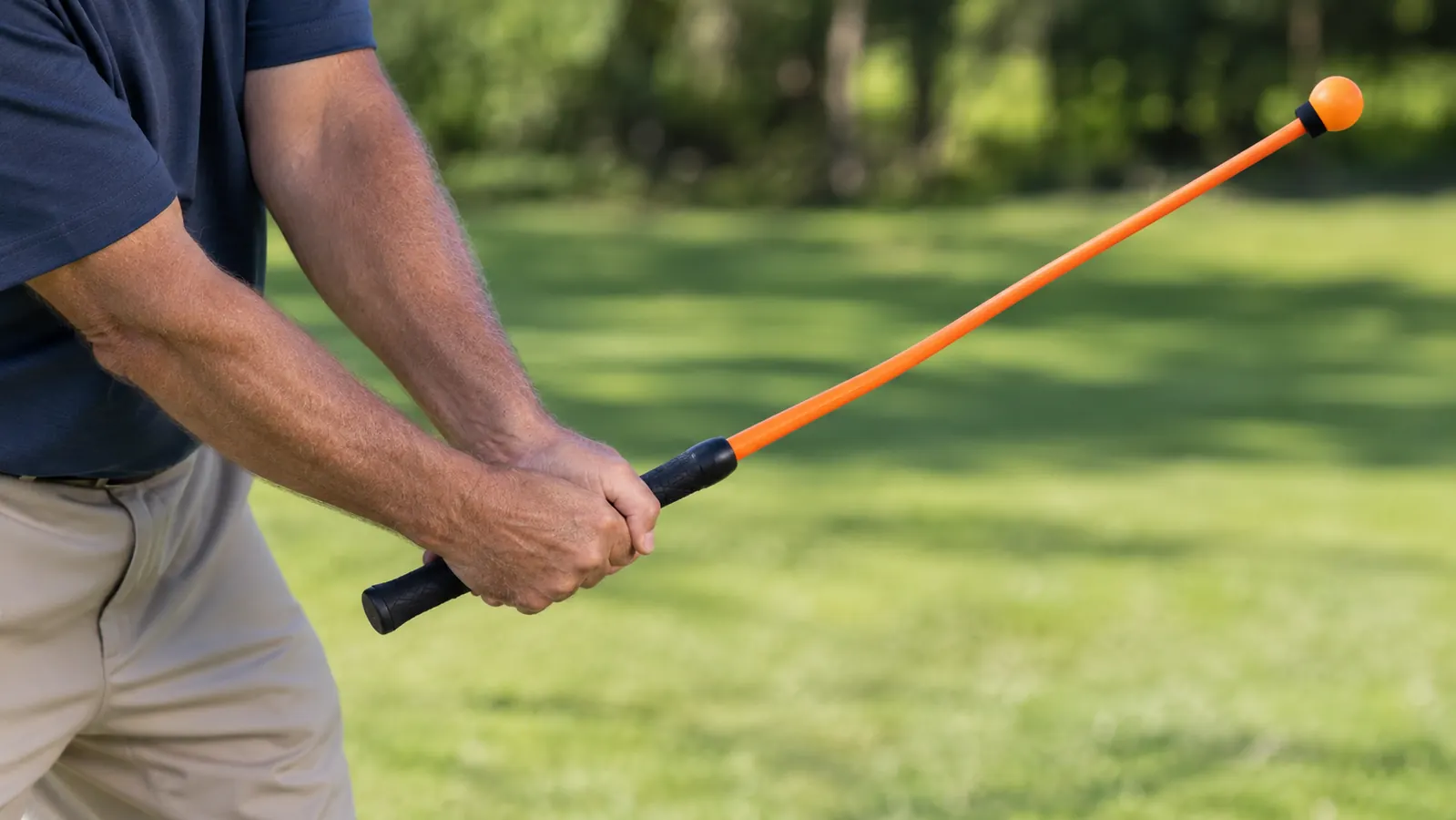
The Orange Whip is a flexible shaft with a weighted ball on the end and a counterweight above the grip, made in the USA. I swing it in the backyard most mornings I play, which is usually Tuesday, Thursday and Saturday. I also take a few swings in the parking lot before a round, and sometimes in the evening when my back is already talking to me after a round. It never comes indoors; it leans against the wall by the back door.
My routine is simple. I start with a few slow half swings, letting the shaft bend and unbend on its own, then I take full swings at maybe half effort. The key is that I do not try to hit anything. The Orange Whip is not a club and it does not behave like one. It bends, it wobbles, and if you rush the transition, the weighted end drags behind you and you feel it instantly. My physical therapist told me years ago to warm up before I twist my back into a golf swing, and this is the most pleasant way I have found to actually do that.
A typical golf morning goes like this. I pour a cup of coffee, step out the back door while Carol is still reading the paper, and take ten or twelve swings on the patio before I load the bag. I start with half swings, slow enough that the shaft bends and straightens on its own, and I let the weighted end do the work instead of my hands. Then I take four or five full swings at maybe half effort. On cold mornings, which in Ohio means anything below about 50 degrees, I add a few extra swings, and I can feel my lower back loosen up in a way it never does from just standing around. One Saturday last month I skipped the routine because I was running late, and I could feel it. Not in my score, but in my body. I was tight over the first few swings and my lower back was complaining by the fourth hole, which used to be my normal. It took me half the front nine to loosen up. I have not skipped it since, even on mornings when I would rather stay inside.
I do not bring it to the range; it stays in the backyard and comes along for a few swings in the parking lot before a round. I take ten swings with the Orange Whip before I touch a club, and I have noticed that my first few real swings are smoother than they used to be. I am not a coach and I do not pretend to teach anyone else, but the feedback is honest: when I rush, the whip tells me before my back does.
What the Orange Whip Actually Trains
The Orange Whip rewards a smooth, unhurried tempo, and it feels clunky if you rush it. That sounds simple, but most training aids I have handled try to fix your swing path or your plane or your release. This one does not care about any of that. It cares about one thing: whether your swing is smooth from start to finish.
When I swing it well, the shaft loads and unloads in a rhythm that feels almost musical. When I swing it badly, the weighted ball lags behind, the shaft wobbles, and I feel like I am wrestling a fishing rod. That contrast is the whole point. My bad swings feel bad immediately, not three holes later when my back starts to complain.
The counterweight above the grip is the part I did not expect to notice. It changes the balance of the thing so the club feels lighter and the weighted end feels heavier, which makes me slow my hands down without thinking about it. I am not going to pretend I understand the physics. I just know that when I swing the Orange Whip for a few minutes and then pick up my driver, the driver feels light and easy.
One evening in July I tried to see what would happen if I swung it as hard as I could, the way I used to attack my driver. The shaft bent so far that the weighted ball felt like it was trying to catch up with my hands, and the whole thing shuddered at the top of the swing. It was not a pleasant feeling, and it was exactly the lesson I needed. My real swing does the same thing when I rush it, I just never noticed, because a golf club is stiff enough to hide the mistake. The Orange Whip makes the mistake obvious. Once you feel it a few times, you start slowing down on your own, without anyone telling you to. That is the whole trick of the thing: it does not train you with instructions, it trains you with a feeling.
The Orange Whip is the first training aid I have owned that made my bad swings feel bad right away, instead of three holes later when my back started complaining.
What Changed After Seven Months
The most noticeable change is not in my swing. It is in my back. I used to feel a familiar tightness in my lower back on the first tee, especially on cold mornings. That tightness has not disappeared, but it is less and it starts later. I still get stiff in the morning, and I still get sore the evening after a round if I walked all 18. What changed is that the first few swings of the day do not feel like a warning anymore.
My tempo is better too, in the way a 16 handicap can notice. I hit the ball solidly more often, especially with my irons, and I have stopped trying to murder the ball off the tee. The Orange Whip did not fix my swing, because nothing fixes a swing that has 45 years of habits in it. But it gave my body a reminder of what a smooth swing feels like, and I can carry that feeling onto the course.
I have also started paying attention to which clubs feel different, and my irons are where the carryover shows up most. I used to stand over a 7-iron and think about swinging hard, and my shoulders would tense up before I even started. Now I think about the feeling of the Orange Whip swinging itself, and the 7-iron comes through smoother without me forcing it. I am not suddenly hitting the ball farther, and I am not going to claim a number I cannot back up. But I am making solid contact more often, and for a 16 handicap that is the difference between a good round and a frustrating one. My playing partners have said something about it a couple of times, which surprised me, because they are not the type to hand out swing advice.
There were weeks when I did not use it, especially in June when I had a cold and skipped a few rounds. I noticed the difference when I came back. My first round without the warm-up was stiff and rushed, and I shot a number I would rather not repeat. The next week I went back to the backyard routine and the first tee felt like me again. That contrast convinced me the Orange Whip is doing something real, not just giving me a nice pre-round ritual.
Where the Orange Whip Falls Short
The Orange Whip is not a fix for a broken swing. If you have a serious flaw in your takeaway or your downswing, this thing will not diagnose it for you. It only gives feedback on tempo, and tempo is one piece of a puzzle that includes setup, plane and a hundred other things I do not fully understand.
The other honest limitation is that it only works on the part of the swing it was built for. It will not tell you anything about your grip, your stance, or where your club face is at impact. I have played long enough to know my own flaws, and the Orange Whip does not care about most of them. It cares about tempo and nothing else. If your problem is a slice that comes from an open club face, this trainer will not fix it, because it never gives you feedback on the face. That is fine with me, because tempo is my problem. But a golfer with a different flaw should not expect a cure-all here, because it is not one. It is a tempo tool, and it is a very good tempo tool, but it is not a swing doctor.
It also takes a little patience. The first week I swung it, I did not feel anything magical happening. It was just a bendy stick with a ball on the end. The payoff came after a month of using it consistently, when the smooth feeling started to carry over into my actual swing. If you are looking for a quick fix, this is not it.
And I will be honest: it does not replace the things that actually manage my back. I still use my foam roller on the living room rug most evenings, and I still wear my back brace on cold mornings when my back is already stiff. The Orange Whip is part of a routine, not the whole routine. Anyone with real back pain should talk to a doctor or physical therapist before trusting a training aid to help.

How It Compares to the Other Things I Own
The Orange Whip is the only swing trainer I have ever owned, so I cannot compare it to a dozen others. But I can compare it to the rest of my warm-up gear. My Callaway Alignment Stix live in my bag and I use them at the range to check my setup, but they do not tell me anything about tempo. My foam roller is for after the round. My back brace is for the cold mornings when my back is already stiff. The Orange Whip is the only piece that actually prepares me to swing, right before I swing.
A friend at the range let me try his Callaway Swing-Easy once. It is a similar idea, a weighted trainer that rewards smooth tempo, and I could see it working for someone who prefers a different feel. But I have only handled it briefly, so I will not pretend to have a long-term opinion. The Orange Whip is the one I bought, and it is the one I keep reaching for.
One thing I appreciate is that the Orange Whip does not need a mat, a net, or a clear spot in the garage. My hitting mat stays in the garage for winter practice, and my alignment sticks need the range or the mat. The Orange Whip works anywhere there is enough room not to hit the house. I have swung it in the backyard in the dark after a late round, and in a corner of the parking lot before a Saturday tee time. That convenience is a big part of why I actually use it, because the best training aid in the world is worthless if it is inconvenient enough to skip.
What I Liked
- Rewards a smooth tempo and punishes rushing immediately
- Doubles as a pre-round warm-up that my lower back appreciates
- Made in the USA and built like it will outlast me
- Counterweight makes my real clubs feel lighter in my hands
- Easy to use in the backyard or parking lot, no setup needed
Where It Falls Short
- Does not fix swing flaws beyond tempo
- Took about a month of consistent use before I felt real carryover
- Not a substitute for medical care for real back pain
- Feels odd for the first few sessions, which might put some people off
Who This Is For
The Orange Whip is for golfers who know they rush their swing and want a physical reminder to stop. It is especially good for older players whose backs do not like a violent transition, because the warm-up value is as real as the tempo training. If you are a recreational golfer who plays a few times a week, wants to feel smoother and less stiff, and is willing to spend ten minutes swinging a weird weighted stick in the backyard, this is worth a serious look.
Who Should Skip It
Skip it if you expect a training aid to fix your swing for you. It will not. Skip it if you are not going to use it consistently, because a week of swinging it and then leaving it in the garage will not do anything. And if your back pain is real, ongoing or getting worse, do not buy a training aid before you talk to a doctor or physical therapist. The Orange Whip helps me feel less stiff, but it does not treat anything.
Seven months in, I would buy the Orange Whip again without hesitating
It is the only training aid I own that I actually use every week. If you rush your swing and your back lets you know about it, this is worth trying.
Amazon Check Today's Price on Amazon →