
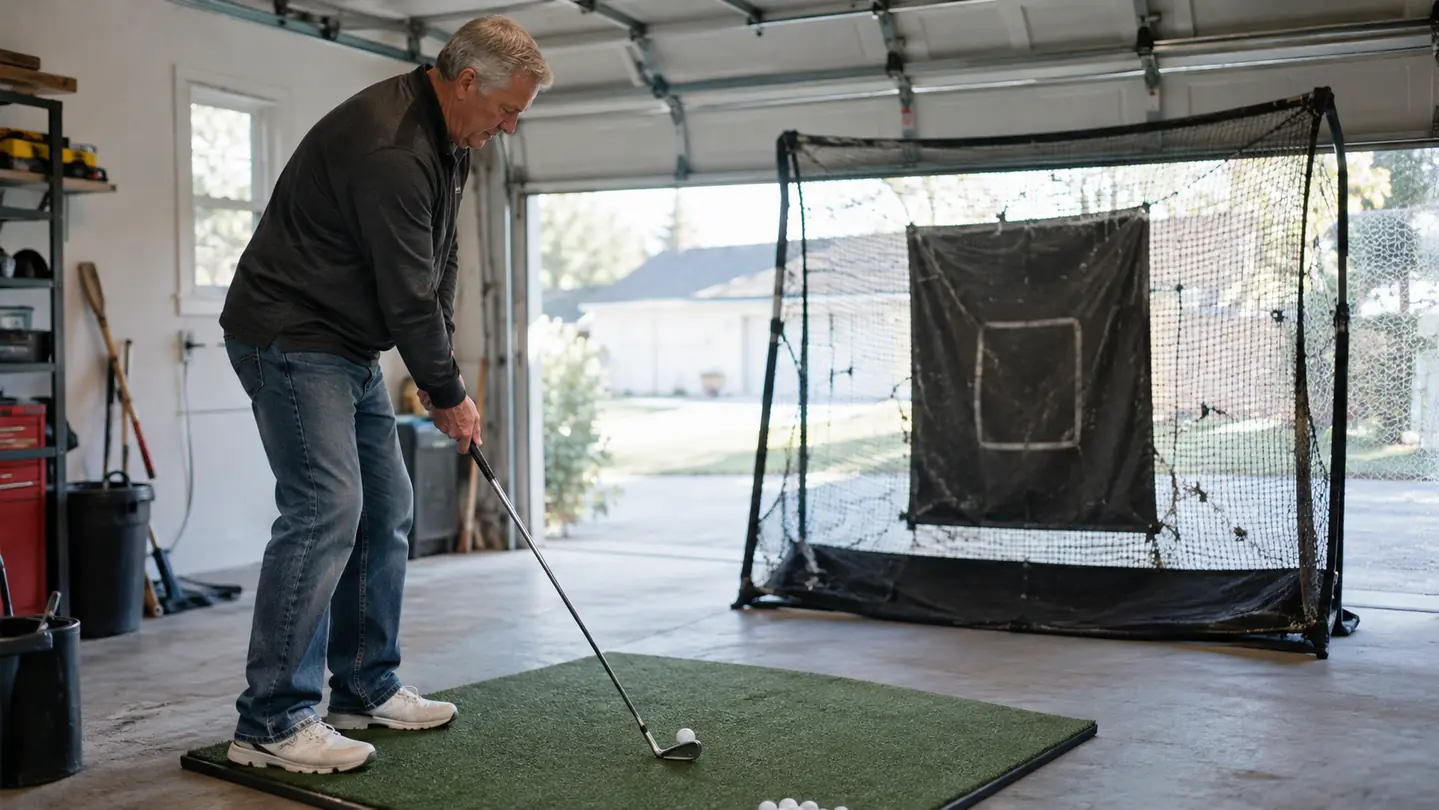
About four years ago I found out what a long range session can do to a lower back that is not as young as it used to be. In the autumn of 2022 I spent a long evening hitting balls at the range, felt fine at the time, and woke up the next morning barely able to get out of bed. Six visits with a physical therapist got me moving again, and her advice was simple: never hit off a surface that does not give a little. That is how I ended up with the GoSports Elite Golf Hitting Mat on my garage floor in November of last year, right before the snow started.
I am Russ, I am 63, and I have played golf three times a week for longer than I like to admit. My handicap sits around 16, which is a polite way of saying I am never going to be on television. What I do have is a lower back that stiffens up in the morning and after a round, and a long Ohio winter that used to mean three months with no swings at all. The GoSports mat changed that. I have hit balls off it most weeks since November, and this is what that has actually been like.
The Quick Verdict
A well-cushioned practice surface that has survived a full Cleveland winter and let me keep my swing going without wrecking my back. It will not fix a bad swing, but it does what a mat is supposed to do.
Amazon Check Today's Price →Keep Your Swing Alive All Winter
The GoSports Elite mat gives you a real turf feel in the garage, with a cushioned base that is easier on a stiff back than a thin foam mat. I have used mine for months and it still looks and hits like new.
Amazon Check Today's Price on Amazon →How I've Used It
The mat lives on the garage floor, and I hit into an old practice net I have had for years. My golf days are Tuesday, Thursday, and Saturday mornings at a public course, so the mat gets most of its use on the evenings in between, usually a couple of times a week after dinner, and sometimes on a winter morning when the course is closed. I take real clubs to it: wedges, a 7-iron, and occasionally a driver off a tee. The mat came with rubber tees, and those have held up fine.
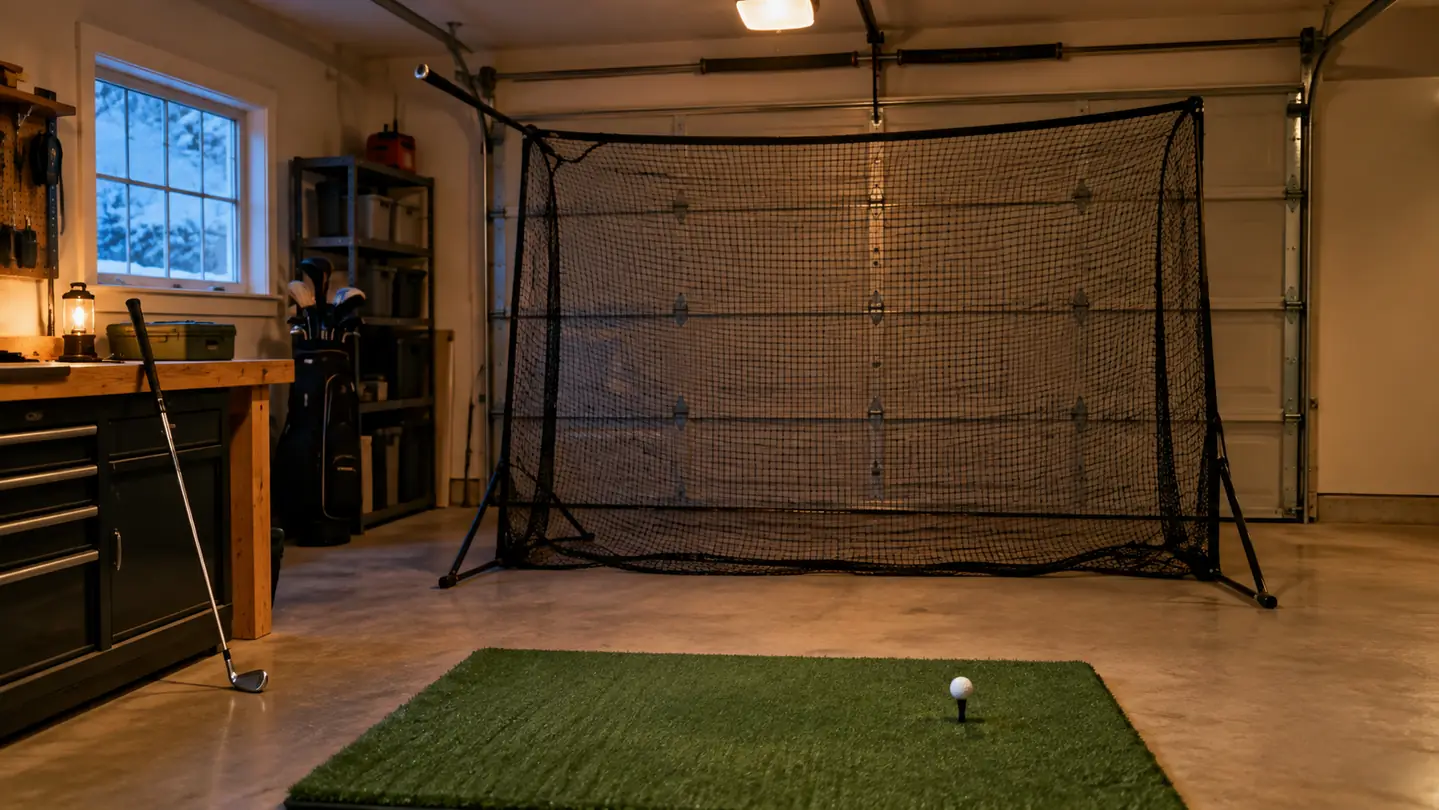
I have never left it outside. It sits on concrete in an unheated garage through snow, ice, and the kind of damp cold that gets into your bones, and it has not curled, cracked, or flattened. That was my biggest worry when I bought it, and it turned out to be a non-issue.
One evening in late January, with the garage cold enough that I could see my breath, I hit fifty balls and the mat never went stiff the way I half expected it to. That was the night I stopped worrying about whether it would survive the winter. I also bring my Alignment Stix out a couple of times a week. I lay one along my target line at my toes and one just past the ball, and it keeps me honest about where my feet are pointing. That is harder to check at the range, where there is usually someone waiting behind you.
The other thing I do is keep my warm-up honest. My wife Carol was the one who pointed out, kindly, that I stopped doing my stretching routine once I started practicing in the garage. She was right. Now I roll out my back and legs on the foam roller in the living room before I go out, and I take a few easy swings with a short iron first. The mat rewards that: when I rush my tempo, the ball flies off the turf and I can feel my back tense up by the tenth swing. When I stay smooth, I can hit fifty balls and barely notice I was out there.
What the Cushion Actually Does
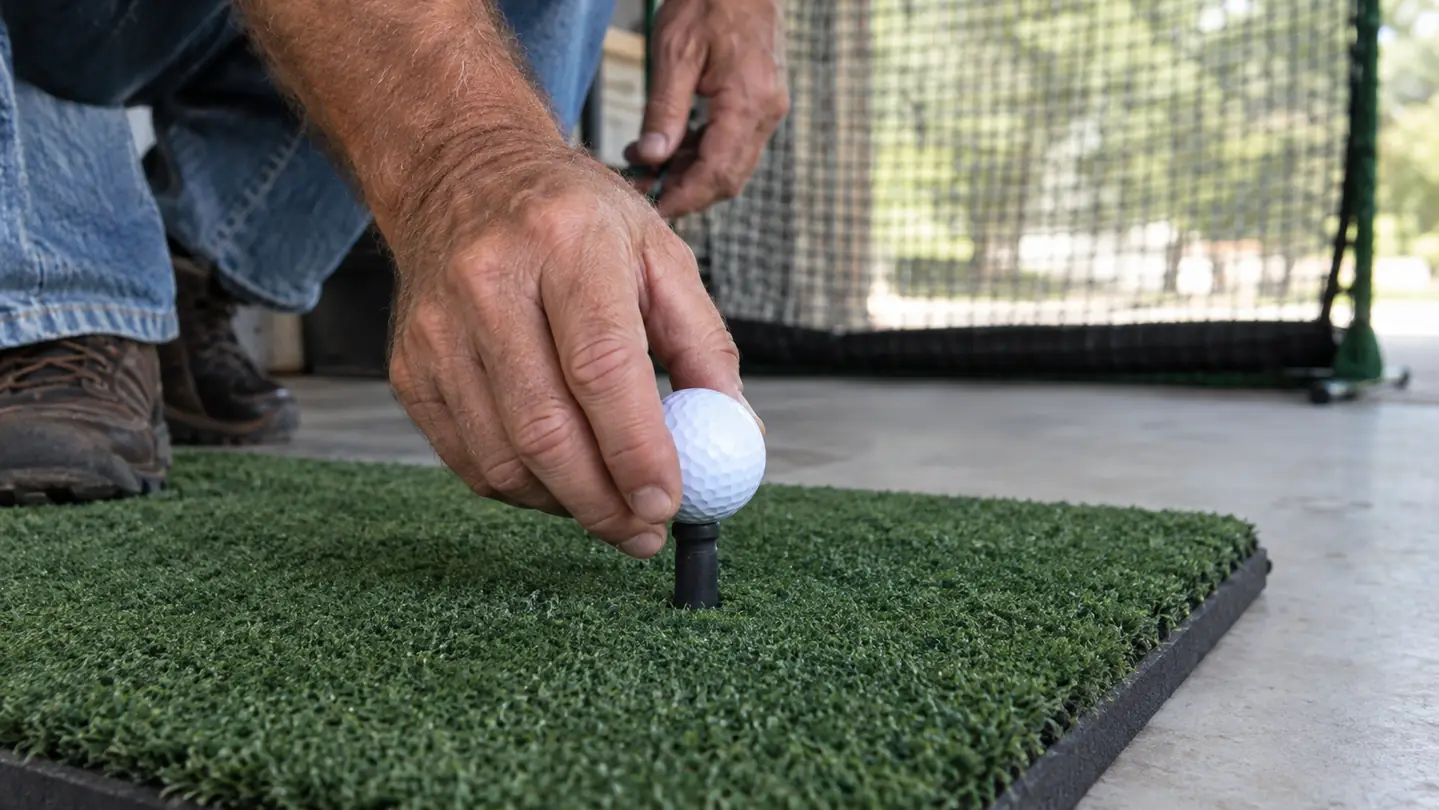
The reason I bought the GoSports Elite instead of another thin foam mat is the cushioned base. I learned the hard way, four years ago, that a hard surface transfers every bit of impact up through the club and into my lower back. Before I bought this one, I tried setting my old foam mat on top of a piece of interlocking garage tile, thinking the tile would add some give. It did not. The tile was hard as a rock under the foam, and after one twenty-minute session my back let me know exactly what it thought of the idea. That experiment convinced me to buy a mat with the cushion built in rather than try to fake it. This mat is built differently. There is a layer of cushion under the turf, and you can feel it the first time you hit a ball. The club does not bounce off the ground like it does on a cheap mat. It settles, the way it does on real turf.
That is not a small thing for a 63-year-old who has had a back strain. I hit the ball first and then take a shallow divot, and on the old foam mat that divot hit a hard floor underneath. Every swing was a tiny jarring thud. On the GoSports mat, the swing finishes through the turf and the ground gives a little. The difference showed up the first Tuesday in December, after about a week of use. I hit my usual fifty balls and realized I had not thought about my back once during the session. On the old setup I was always aware of it by the twentieth ball. I have had exactly one evening where my back was sore after practicing, and it was the night I skipped my warm-up and hit forty drivers in a row. That one was on me, not the mat.
The turf itself has also held up. I was worried that hitting off the same small patch every night would wear a shiny spot or start to shred, the way my old mat did after two winters. After months of use I can see the area where I set up is a little more worn than the rest, but there are no bare spots, no tears, and no loose fibers. It still takes a tee cleanly, and the ball sits up the way it should.
Hitting Off the Turf vs. Off a Tee
The mat handles both. Off the turf, it plays like a decent fairway lie. You can feel the cushion compress slightly under the club, and the ball comes off with a clean strike. It is not exactly like hitting off a real fairway, because nothing is, but it is close enough that my swing does not change when I go back outside in the spring. That consistency is the whole point of a practice mat. My home course keeps its fairways mowed tight, and the mat reminds me of that more than it reminds me of a lush practice range. The ball sits down a little lower, so I have to hit down and through it, which is exactly the move I need on a tight fairway lie. Hitting fifty of those shots a couple of times a week has been better practice for my game than beating balls off a fluffy range mat ever was.
Off a tee, I use the rubber tees that came with the mat. They press into the turf and stay put. I have hit hundreds of drivers off them, and they are still going strong. You can also use the mat without a tee for irons and wedges, which is what I do most evenings. A typical session runs forty or fifty balls. I start with a wedge, move to the 7-iron, and finish with maybe eight drivers off the rubber tee. I do not hit the driver off the turf, because that is not a shot I ever face on the course and there is no point practicing a lie I will never play. The first time I took a real divot on the mat I stopped and looked down, expecting a gouge. There was a faint mark, and by the next session it had faded. The rubber tees are a small thing, but they mean you do not have to buy anything else to start practicing the day the mat arrives.
Does It Help a Stiff Back?
I want to be careful here, because I am not a doctor and I am not a physical therapist. What I can tell you is my own experience. The cushioning takes away the jarring that used to make my back tighten up during a long session. I pay attention to how my back feels the morning after practice. On the old foam mat, the morning after a session was usually a stiff, slow start. On the GoSports mat, most practice mornings feel noticeably easier. That is not a medical study, it is just one golfer paying attention, but it has been consistent enough that I trust it. I still get stiff in the morning, and I still get sore the evening after a round in the summer. But I no longer wake up the day after a practice session feeling like I have been through something. That is a real difference, and it is the reason the mat stays in my routine.
I will also say this: a mat cannot fix a bad swing, and it cannot fix a bad back. If you have real pain, go see a doctor or a physical therapist. My physical therapist told me years ago to roll out my upper back, glutes, hips, and hamstrings, and never directly on my lower spine, and I still follow that. One thing the mat changed is how long a session can last. Twenty minutes was about my limit on the old setup before my hands and my back started complaining. Now forty-five minutes is normal, and it is usually the clock that ends the session, not my back. The swing has not changed, because I am the same golfer I was. The surface is what changed. The mat is part of the system, not the whole system. I use it with my foam roller before and after, my back brace on cold golf mornings, and, since March, my Orange Whip for tempo. Together they keep me playing three times a week.
I have hit balls off this mat most weeks since November, and I have had exactly one evening where my back was sore afterward. That one was my fault for skipping the warm-up.
What I'd Change
If I were being honest, there are a couple of things I would tweak. First, the mat needs its own patch of garage floor. I have the space, but if you are working with a tight corner, measure before you buy. Second, it is not something you want to pick up and move every day. I leave mine in place and walk around it with the lawnmower in the summer.
The other thing is that the turf does have a break-in period. The first couple of sessions it felt slightly firm, almost like the cushion needed to loosen up. After a week of use it settled in, and it has felt the same ever since. That is worth knowing so you do not judge it on day one.
What I Liked
- Cushioned base absorbs impact that used to reach my lower back
- Turf has held up through months of winter use with no tears or bald spots
- Rubber tees included, so it is ready to use the day it arrives
- Works equally well off the turf and off a tee
- Solid enough to stay put on concrete, no sliding during a swing
Where It Falls Short
- Not something you want to move around often
- Takes up a decent amount of garage floor
- Needs a short break-in period before the turf feels settled
How It Compares to My Old Foam Mat
Before the GoSports mat, I practiced for two winters on a thin foam mat that I finally threw out when it flattened. The difference is night and day. The old mat sat directly on concrete, so every shot sent a shock up the shaft and into my hands and back. After twenty minutes I would feel it. The GoSports mat has that layer of cushion underneath, and I simply do not feel the same jarring.
The old mat also wore out. By the end of the second winter it had a shiny bald patch right where I set up, and the ball did not sit up properly anymore. The GoSports mat shows some wear in the same spot after months of use, but it still performs the way it did in November. That is the difference between a mat built for occasional indoor practice and one built for the long haul.
Who This Is For
This mat is for the golfer who wants to keep swinging through the winter, or the one who wants a real practice surface in the garage without driving to a range. It is especially good for anyone who has ever felt their back or joints complain after hitting off a hard surface. If you are in your fifties or sixties and you want to protect your back while you practice, the extra cushion is worth it.
Who Should Skip It
Skip it if you only hit a few balls a few times a year, because a cheaper mat would probably do. Skip it if you are expecting it to improve your swing on its own, because no mat does that. And if you have actual back pain, do not buy a mat instead of seeing a doctor. I say that as someone who has been through it. The GoSports mat is a tool for practicing comfortably. It is not medical advice, and it is not a cure for anything.
The Mat That Got Me Through Winter
Months of evening practice in an unheated garage, and the GoSports Elite still hits like new. If you want to keep your swing together when the course is covered in snow, this is the mat I would buy again.
Amazon Check Today's Price on Amazon →