

I will be honest with you. I bought the Callaway Alignment Stix in April of 2025 because they were inexpensive and I needed something that would make my range sessions feel less aimless. I am 63 years old, I play golf three times a week at a public course outside Cleveland, and I carry a handicap around 16. I am not a teaching pro. I am a retired shop teacher who wants to keep playing decent golf while managing a lower back that gets stiff if I do too much twisting. That context matters, because the way I use these sticks is probably not the way a college golfer would use them.
After a full season with these sticks and a second season now wrapping up, here is the honest version. They are about as simple as a training aid can be: two bright yellow 48-inch sticks that collapse into short sections so they fit in a golf bag. You lay one on the ground along your target line and one along your ball line, or you use one as a guide for your swing plane. That is the whole thing. There is no motor, no app, no screen, and no way to cheat the feedback. If your feet are pointed right of where your club is aimed, the sticks will show it to you every single time.
The Quick Verdict
A simple, honest training aid that does exactly what it says if you actually use it. It will not fix your swing, but it will show you what your swing is doing, and that is worth a lot to a golfer with a stiff back.
Amazon Check Today's Price →If you want the cheapest honest feedback you can put in a golf bag
The Callaway Alignment Stix have lived in my bag for a year and a half. They take ten seconds to set up, they never need charging, and they work on grass or on the garage mat. Check today's price on Amazon if you want to see whether they fit your routine.
Amazon Check Today's Price on Amazon →How I've Used Them
I keep them in my bag every round, even though I mostly use them at the range. On a typical week I play Tuesday, Thursday, and Saturday mornings, and I hit balls one extra evening. On that range evening I pull out the sticks first thing, before I even take a club out of the bag. It takes maybe twenty seconds to snap them together and lay them down. That small ritual matters. Once they are on the ground, I have to be honest with myself about where I am aimed.
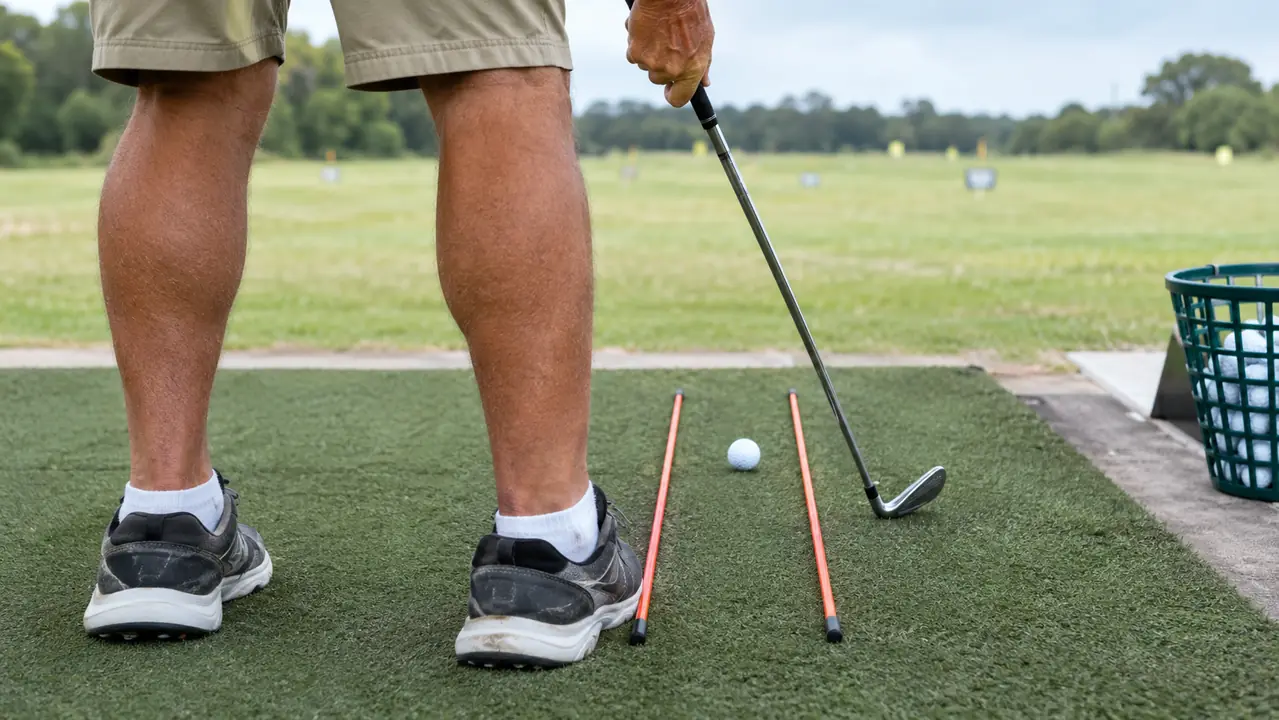
I use one stick along my toe line, pointing at my target. The other goes just outside the ball, parallel to the first. That sounds like the same thing, but it is not. The toe line stick tells me where my feet are aimed. The ball line stick tells me where the club is aimed. When those two lines are not parallel, I can see it immediately, and that is the whole point. Most of my bad shots start with a setup that is slightly off, and the sticks catch that before I ever swing.
People assume alignment sticks are for beginners. I use them because my back changes how I set up. Some mornings I am a little stiff and I stand closed without noticing. The sticks do not care about my excuses. They just show me the lines. That is the most honest feedback I own. On the days when I feel tight, I will set up to the sticks and then take a few slow practice swings before I hit a real ball. It is a way of telling my body, this is where square is, before we start twisting.
What Nobody Tells You About Alignment Sticks
First, they do not fix anything. That sounds obvious, but it is the thing every review dances around. An alignment stick is a mirror, not a teacher. It shows you where your feet and club are pointed, and it shows you where your swing plane is. If you do not know what good alignment looks like, the sticks will just confirm that you are consistently wrong. You still need a lesson or a video or a friend who knows what they are looking at. I had a physical therapist give me a few setup cues for my back, and years later, the sticks let me practice those same cues on my own.
Second, the collapsible design is convenient but not flawless. The sections snap together quickly, and the fit is snug. That is the tradeoff. A solid one-piece stick is stiffer and never wiggles, but it does not fit in a bag. The Callaway sticks have lived in my bag for over a year and the joints are still tight. I have had one section pop loose when I dropped the bag, but it snapped back in two seconds. You are trading a little rigidity for a lot of convenience, and for me that is a fair trade.
Third, they are only useful if you have a routine. The most common thing I see at the range is people buying alignment aids, using them for one session, and then leaving them in the trunk. I fell into that pattern too. What changed for me was putting them in the bag so they are always there. If they are not with your clubs, they are just something you meant to use. The same goes for any practice aid. The gear is not the hard part. The habit is the hard part.
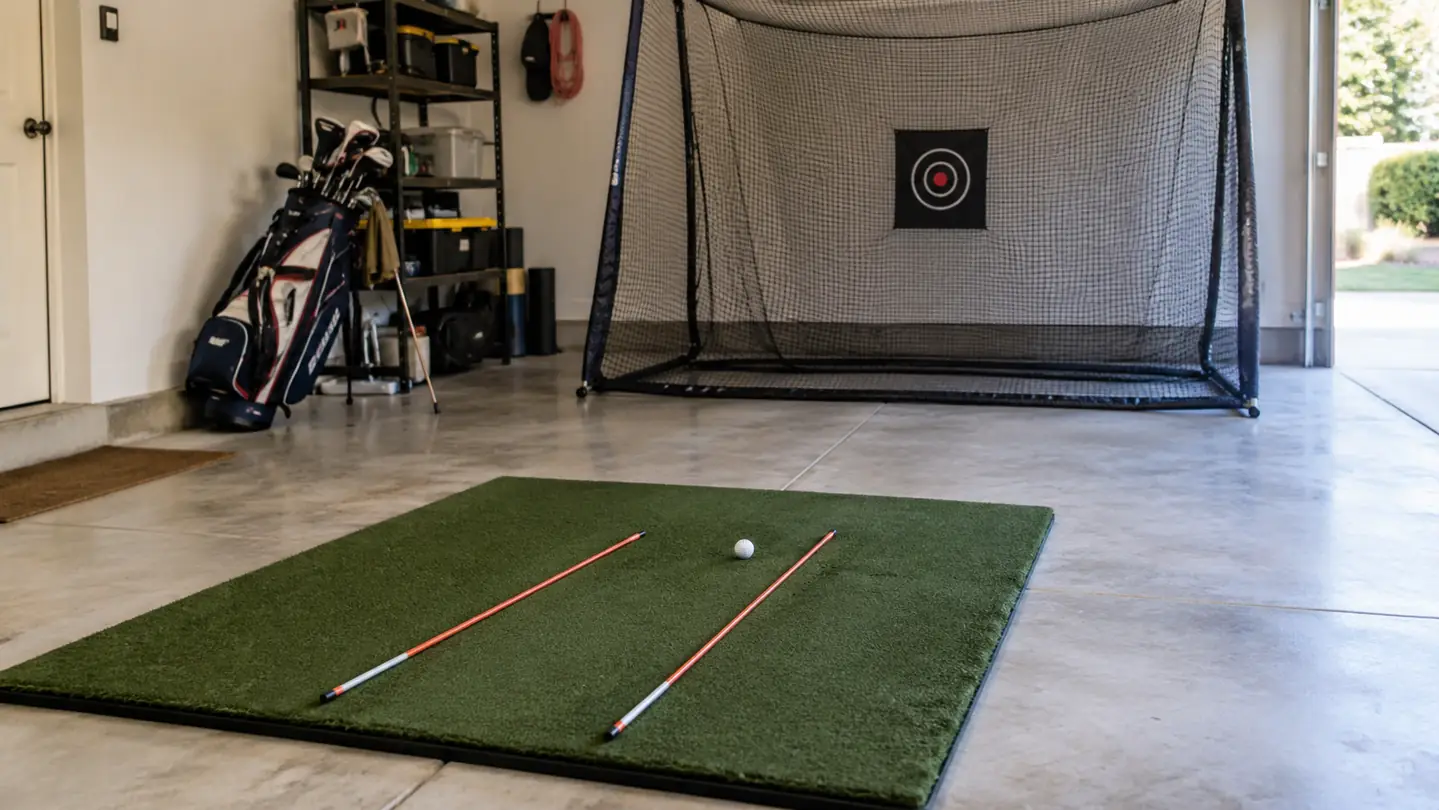
Fourth, you do not need a fancy mat. I use them on the hitting mat in my garage during the winter, and they work fine on the artificial turf. On a grass range they work even better because you can push the bottom of the stick into the turf and it stays put. On the mat they can slide a little, so I lay a towel under them if the surface is slick. That is a small detail, but it is the kind of detail nobody puts in a review.
An alignment stick is a mirror, not a teacher. It shows you where your feet and club are pointed, and it shows you where your swing plane is.
The First Week: What I Learned
The first time I used them, I was a little embarrassed. I had been telling myself for years that my alignment was fine. The sticks told me otherwise. My feet were aimed noticeably right of where the club was aimed, which explains a lot of the shots I thought were fades. It was not my swing path. It was my setup. That is the kind of discovery you only make when you put a straight line on the ground and have to look at it.
By the second range session I had stopped fighting the sticks and started using them. I would set them up, take a club, and make five or six practice swings without a ball, just to feel square. Then I would hit a few balls and reset. That rhythm turned my practice from hitting a hundred balls into hitting fifty good balls with a clear intention. I cannot tell you the sticks improved my score by some number, because I do not track that way. I can tell you they improved my practice.
The one thing that surprised me was how much I used them in the garage over the winter. I have a small hitting mat and an old net, and the sticks turned that setup into something close to a real range. I could work on alignment without driving anywhere. For a guy in his sixties with a back that does not like cold weather, that is a real benefit.
How I Use Them for Swing Plane
The second common use for alignment sticks is as a swing plane guide. You push one stick into the ground at an angle, roughly matching the angle of your shaft at address, and then you swing under it or over it depending on what you are working on. I use this mostly for my driver, because that is where I get steep when my back is stiff. The stick gives me a visual target for where the club should be, and I make slow swings trying to miss it by the right amount.
I am not going to pretend I do this perfectly. A one-piece stick is better for this job because it is stiffer and does not flex at the joints. The collapsible Callaway sticks flex a tiny bit when you use them as a plane guide, especially if you lean on them. It is not a problem for light use, but if you want to hammer the stick into hard ground and swing hard against it, a solid stick is a better tool. For me, the flexibility is a fair trade because I mostly use them for alignment anyway.
How They Fit Into My Back Routine
The honest context is that I bought these sticks the same spring I was dealing with a lower back that got stiff after long range sessions. The back strain started about four years ago, after a day when I hit too many balls. I saw a physical therapist for six visits that winter, and the best advice I got was to warm up properly and stop twisting hard when I was cold. That advice changed how I practice more than any piece of gear did.
The Alignment Stix play a small but real role in that. Before every range session I do a few slow swings with the sticks as a guide. I lay one stick on the ground and I make sure my feet are square to it before I start. That means I am not starting every session from a slightly closed stance, which was my way of compensating for a stiff back. When I skip that step, I can feel it in my left hip by the end of the round.
On the course I do not use them during a round, obviously. They stay in the bag. But the habit of checking my alignment at the range carries over. I also use them at home on the garage mat in the winter, which has made a difference in how my swing feels when the season starts. My wife Carol is the one who pointed out that I was skipping my warm-up on cold mornings, and she was right. I should also say that the sticks are not the main thing that keeps my back comfortable. The main things are the foam roller in the living room and the warm-up I do before the first tee. The sticks are a small piece of the puzzle, but they are a useful piece.
What I Would Change
If I could change one thing, it would be the storage. The sticks come as a set of two, and when they are collapsed they fold short enough to ride in the side pocket of my stand bag. Now and then they get tangled with my rain jacket in there. That is the only storage note I have.
The other thing I would change is the stiffness when used as a plane guide. As I said, the joints flex a little. It has never caused a problem in a season and a half, but if I were a younger player swinging harder, I would probably want the one-piece version for that specific drill. For alignment, the collapsible design is perfect. I am not sure a single product can be perfect at both jobs, so I am not holding that against the Callaway sticks.
The Bottom Line
After a season and a half, I would buy these again. They are not the most exciting piece of gear I own, but they are the one I reach for most often at the range. They take up almost no room in the bag, and they give me feedback I can actually use. For a recreational golfer with a stiff back who wants to practice smarter instead of harder, that is a good deal.
Pros and Cons
What I Liked
- Dead simple to use, no setup learning curve
- Collapsible so they fit in a golf bag
- Honest visual feedback on alignment and swing plane
- Useful at the range and on a garage mat
- No battery, no app, nothing to break
Where It Falls Short
- They only show problems, they do not fix them
- Joints can pop loose if the bag is dropped
- Easy to forget if you do not build a routine
- A one-piece stick is stiffer for plane work
- Not much help if you do not know what good alignment looks like
Who This Is For
These sticks are for the recreational golfer who already knows they set up crooked some mornings and wants a cheap way to see it. They are for the player who is willing to spend ten minutes at the range checking lines before hitting balls. They are for the person, like me, whose body changes from one day to the next and needs a neutral reference point. If you are taking lessons, these are a perfect complement because they give you something concrete to practice between lessons. If you are working with a physical therapist or a coach on setup changes, the sticks let you practice those changes without needing someone to stand behind you.
Who Should Skip It
Skip them if you are expecting a training aid to change your swing on its own. They will not. Skip them if you never practice, because a tool you do not use is just something in the garage. And skip them if you already have solid alignment and a consistent setup, because the sticks will mostly tell you what you already know. There is also an argument for a single one-piece alignment stick if you mainly want a stiff guide for swing-plane work, but then you are giving up the convenience of something that fits in your bag. I own the collapsible set, and I am glad I do.
Still worth a spot in my bag after 18 months
I have owned the Callaway Alignment Stix since April 2025, and they are still the first thing I set up at the range. If you want an honest, inexpensive way to check your alignment, check today's price on Amazon.
Amazon Check Today's Price on Amazon →