
I will tell you exactly why I bought the Callaway Alignment Stix, and it was not because I thought they would fix my swing. It was because I had spent a whole winter aiming well right of where I thought I was aiming, and my lower back was not letting me get away with it anymore. When you are 63 and your back gets stiff after a long range session, you start looking for practice that actually counts. You stop swinging harder and start looking for the reason the ball keeps starting on the wrong line.
The reason, more often than not, is alignment. I am not a teaching pro and I never pretend to be one. I am a retired shop teacher who plays three times a week at a public course outside Cleveland, and I have spent the last few years trying to keep a decent swing while managing a lower back that does not like being twisted. The Callaway Alignment Stix are the simplest tool I have found for catching alignment mistakes before they become habits. Here is how I use them, step by step, and what I would tell a friend who asked.
Stop Aiming Where You Happen to Be Standing
Two collapsible 48-inch sticks that live in your bag and give you a straight answer on the range. This is the exact set I have used for a season and a half.
Amazon Check Today's Price on Amazon →Step 1: Lay the Target-Line Stick First, Before You Even Take a Club
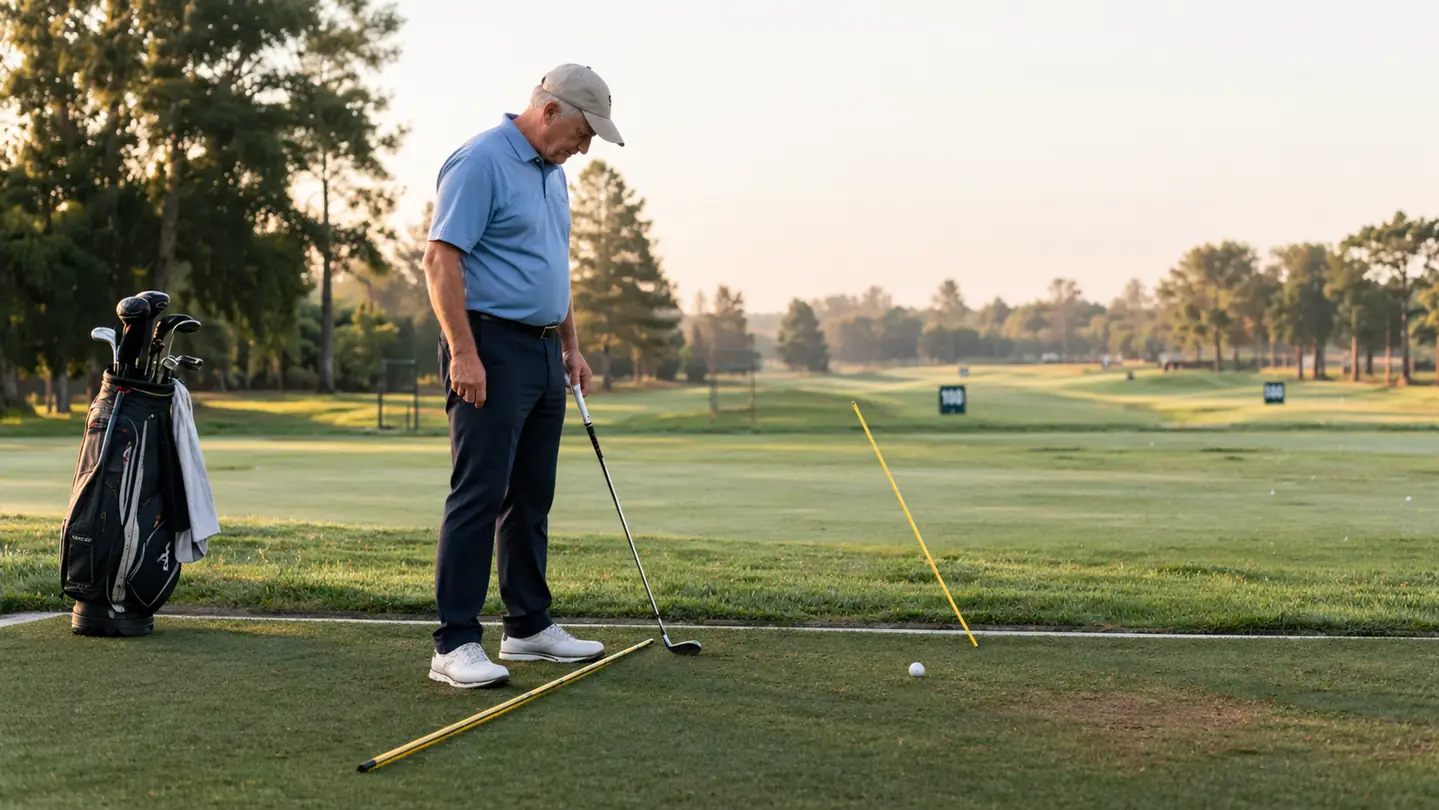
The first Callaway Alignment Stix goes on the ground along the line you want the ball to start on. I pick a specific target, not a general direction. On my home range there is a fence post about 150 yards out, and I lay the stick so it points straight at that post. Then I stand so my toes are parallel to that stick. That is the whole trick, and it is harder than it sounds, because what feels parallel to me is often not parallel at all.
Here is what I learned the first time I did this. I set the stick, stood to it, and felt perfectly lined up. Then I stepped behind the ball and looked. I was aimed at the right edge of the range, well right of the post. My eyes and my body had been lying to me for years, and the Callaway Alignment Stix were the first thing that called them on it. By late April 2025, a few sessions after the sticks arrived, I had learned the basic lesson: what feels square is not square. I would set the stick, stand to it, and my body would insist the line was wrong, even when the stick was pointing straight at the fence post. So I trusted the stick instead of my eyes, and every ball I hit started left of the post. I had overcorrected, and the sticks caught that too. That is when I understood the problem was not my swing that day. It was my setup, and it had been my setup for years. My physical therapist told me back in 2022 that a back that does not like twisting makes you guard against the turn, and that guarding shows up in your aim before it shows up in your swing.
Do this before you take a club out of the bag. If you lay the stick after you have already addressed a few balls, your body will cheat the stick to match your old aim. Lay it first, pick your target, and let the stick tell you the truth.
Step 2: Use the Second Stick at Your Feet, Not as a Decoration
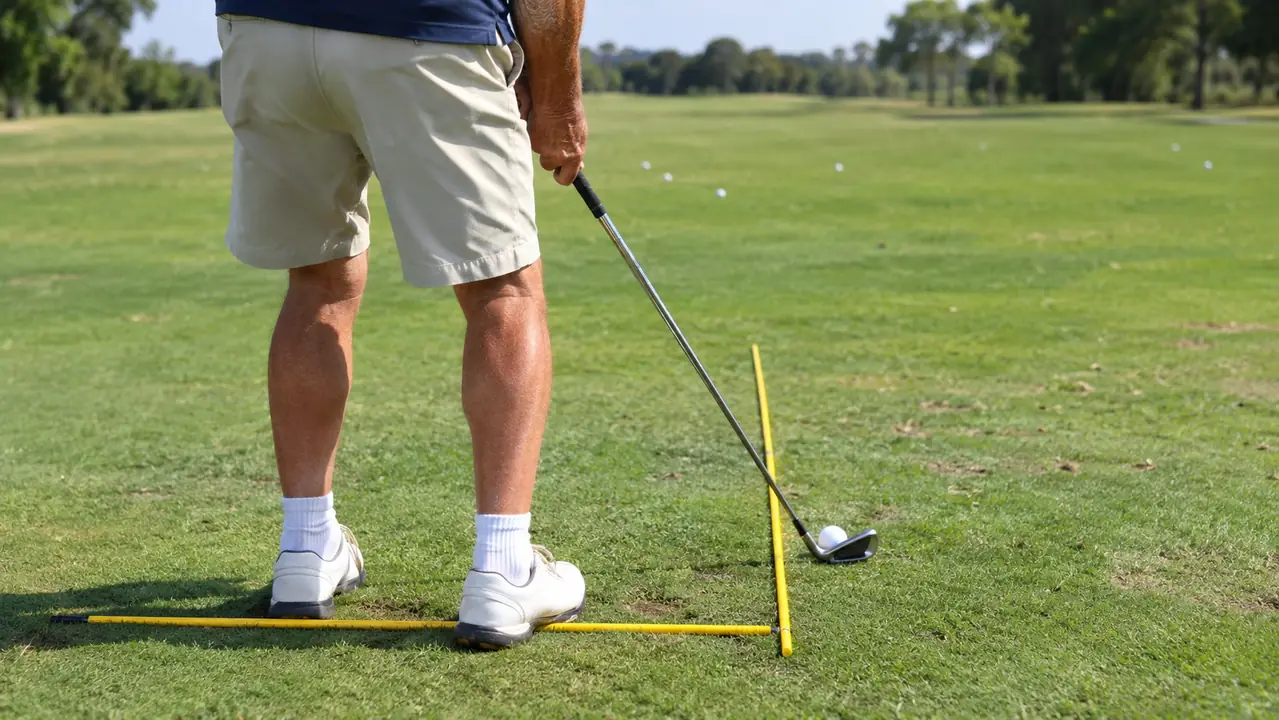
The second Callaway Alignment Stix goes on the ground just in front of your toes, parallel to the first one. This is the stick that does the real work. When I first used both sticks together, I found that my feet were aimed right while my shoulders were aimed straight. No wonder the ball started right and then did something else. My body was fighting itself before I even swung.
The fix is simple. Set the toe stick, stand to it, and then look down. If your toes are not parallel to the stick, adjust your feet first and your shoulders second. I check my shoulders by holding a club across my chest and looking at where it points. It should point parallel to the sticks, not at the target. That is the piece most recreational golfers get backwards, and it is the piece the Callaway Alignment Stix make obvious.
One warning from personal experience. Do not stare at the sticks while you swing. They are a check at address, not a thing to think about during the swing. Set your line, take one look at the target, and swing. If you keep your eyes on the sticks, you will hit the ball exactly where you are not looking.
Step 3: Hit Five Balls With the Sticks, Then Five Without
This is the step that turned the Callaway Alignment Stix from a gadget into a training tool for me. I hit five balls with the sticks down, then I move the sticks away and hit five more trying to keep the same line. Then I put the sticks back and check. The gap between what I think I am doing and what I am actually doing is always bigger than I expect.
The first time I did this, I hit five balls with the sticks and they started on a good line. Then I moved the sticks and hit five more, and three of them started right again. My body had gone back to its old habit the moment the visual check disappeared. That is the whole point of the drill. You are not practicing alignment with the sticks. You are practicing alignment without them, using the sticks to catch yourself when you drift. I keep a rough score for this drill. On a good day, four of the five balls without the sticks start on the line I picked. On a bad day, none of them do, and the sticks are the only reason I know it. One evening last summer I was sure I had finally fixed my aim, because the first three balls without the sticks flew straight. Then I put the sticks back down and checked, and my feet were aimed at the next bay's flag. The habit had crept back in three swings. That is how fast it returns.
I do this at the start of every range session now, before I work on anything else. It takes about ten minutes, and it saves the other forty minutes from being wasted on a swing that is aimed at the wrong part of the range.
Step 4: Take the Same Routine to the Garage Mat in Winter
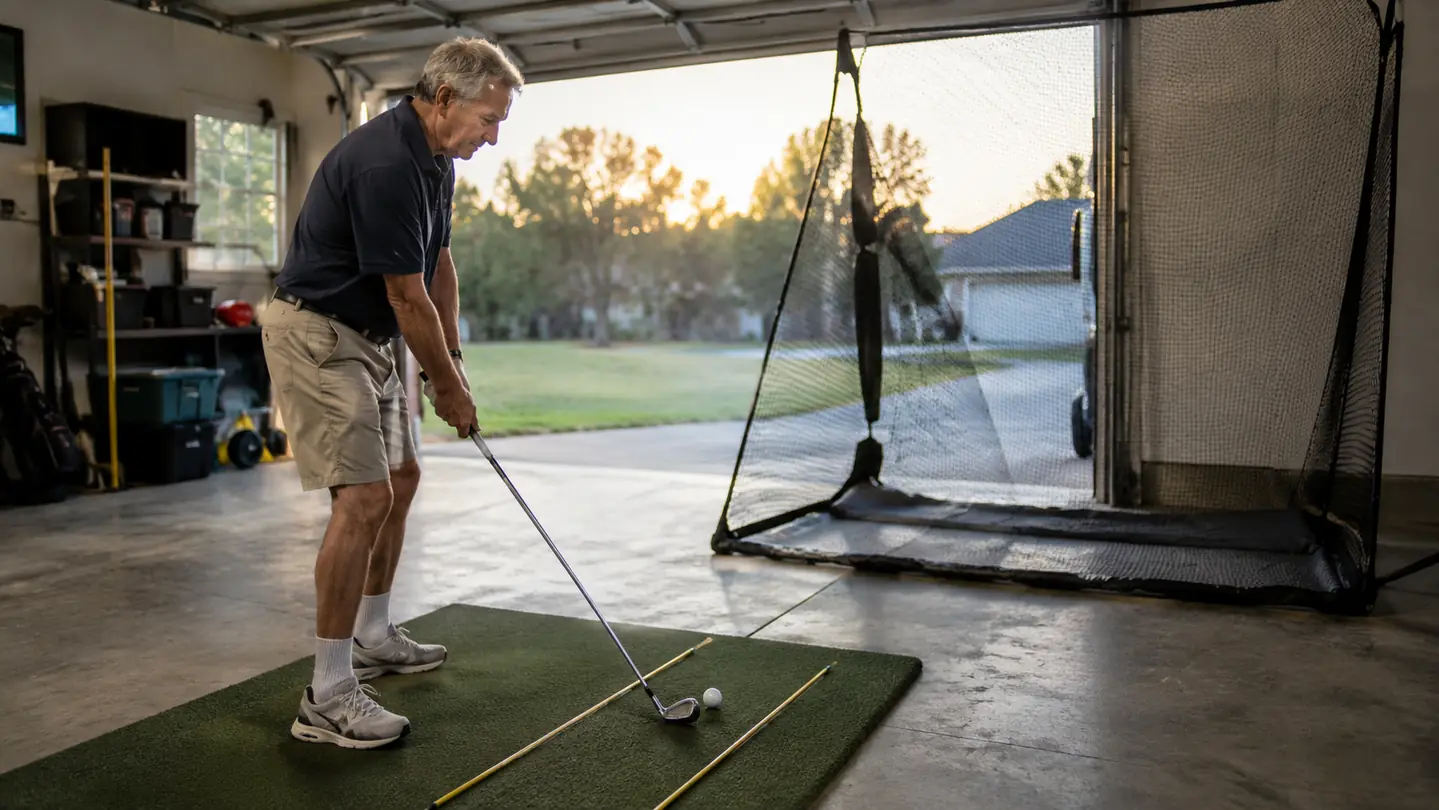
The Callaway Alignment Stix collapse into short sections, which is why they live in my golf bag all season. In the winter they come inside with me. I have a GoSports Elite Hitting Mat on the garage floor and an old hitting net I already owned, and I set the sticks up on the mat exactly the way I do on the range. The garage is colder and the light is worse, but the alignment check works the same. I bought the mat in November 2025, mostly so I would not spend another winter swinging into a net off a concrete floor. It has a cushioned base and came with rubber tees, and the sticks sit on it the way they sit on range turf. The first time I used them together, I noticed something I had missed outdoors. With the garage door closed and nothing to look at but the net, my feet drift even faster, so I check my toes against the stick on every fifth ball.
Winter is when alignment habits really go bad, because you are hitting into a net and there is no target to miss. The ball disappears into the net and your body starts aiming wherever it feels comfortable. The sticks give you a target line even when there is no target. I hit into the net with the sticks down, check my feet, and I can feel the difference in my setup within a few swings.
One practical note. The garage floor is harder than the range, and my back notices. I keep my range sessions in the garage to about 30 minutes, and I use my foam roller on the living-room rug afterward. The alignment work is worth doing, but not worth a week of stiffness.
Step 5: Check Your Alignment on the Course, Not Just on the Range
The range is where you build the habit. The course is where you find out if it stuck. I do not carry the Callaway Alignment Stix onto the fairway, but I do use the same check on the tee box. I pick a spot a few feet in front of my ball on the target line, like a leaf or a discolored patch of grass, and I line my clubface to that spot. Then I set my feet parallel to that line, the same way I set them parallel to the stick on the range.
This is the trick that made the biggest difference for me. On the tee, your brain wants to aim at the flag, which is 150 yards away. Your body cannot aim at something that far away. It needs a near target. The sticks taught me to find a near target, and that habit has saved me more strokes than any swing change I have made in the last two years. It paid off most clearly on the par 3 at my home course that plays about 140 yards over a pond. I used to aim at the flag, pull the ball left, and wonder why. Now I pick a spot a foot in front of the ball, line the clubface to it, and set my feet parallel, exactly the way I set them to the sticks. I hit more greens on that hole in the last six months than in the two years before. The swing did not change. The aim did.
I also do a quick alignment check before my first tee shot on days when my back is stiff. When my back is tight, my body naturally wants to set up closed, because that position feels safer. The sticks on the range remind me what a neutral setup feels like, and I carry that feeling to the first tee. It is not a cure for a stiff back. It is a way to keep a stiff back from turning into a bad aim.
What Else Helps
The Callaway Alignment Stix fix alignment, and that is all they fix. They will not fix a slice, a hook, or a back that hurts. For the back, I do my warm-up with the Orange Whip in the backyard most mornings I play, and I roll out on the TriggerPoint GRID 1.0 on the living-room rug after a round. On cold mornings I wear the Sparthos Back Brace over a thin undershirt, about one round in three. None of that is medical advice. It is just what a 63-year-old recreational golfer does to keep playing three times a week.
If your alignment is off because your body is guarding a sore back, the sticks will show you the symptom but they will not treat the cause. See a doctor or a physical therapist for real or worsening pain. I saw a physical therapist for six visits a few years ago, and the best thing I got from it was a list of stretches and the advice to never roll directly on my lower spine. The sticks are a training aid. They are not a physician.
The first time I set up to the Callaway Alignment Stix, I was aimed 15 yards right of where I thought I was aiming. My eyes and my body had been lying to me for years.
The Cheapest Swing Lesson I Have Ever Taken
Two collapsible sticks, a fence post, and ten minutes at the start of a range session. That is the whole method, and it works.
Amazon Check Today's Price on Amazon →