

Let me start with the part most reviews skip: the Orange Whip looks ridiculous. A flexible shaft with a weighted ball on the end, and you stand in the backyard swinging it in slow motion while the neighbors watch. I am 63 years old, I have been playing at a public course outside Cleveland three times a week for years, and I did not buy one to look cool. I bought one because my lower back got stiff after a long range session about four years ago, and my swing had gotten fast and jerky in a way that made it worse. What I did not expect was that the Orange Whip would slow me down more than any lesson I have taken, and that it would take about seven months of steady use before I could explain why it works.
This is the honest version of that story. The Orange Whip is not magic, it does not cure a bad back, and it will not fix a slice by itself. What it does is one thing, and it does that one thing very well. It teaches you to swing at a tempo your body can actually handle. For a weekend golfer in his sixties with a stiff lower back, that one thing has been worth every swing I have put into it.
The Quick Verdict
Seven months in, the Orange Whip is the best tempo trainer I have used. It will not fix your swing, but it will slow it down until the rest of your practice starts to work.
Amazon Check Today's Price →If your swing has gotten fast and jerky, this is where I would start
The Orange Whip is a simple tool with one job: it slows your tempo down until it feels natural. Seven months of swings on golf mornings and I reach for it before every round.
Amazon Check Today's Price on Amazon →How I've Used It
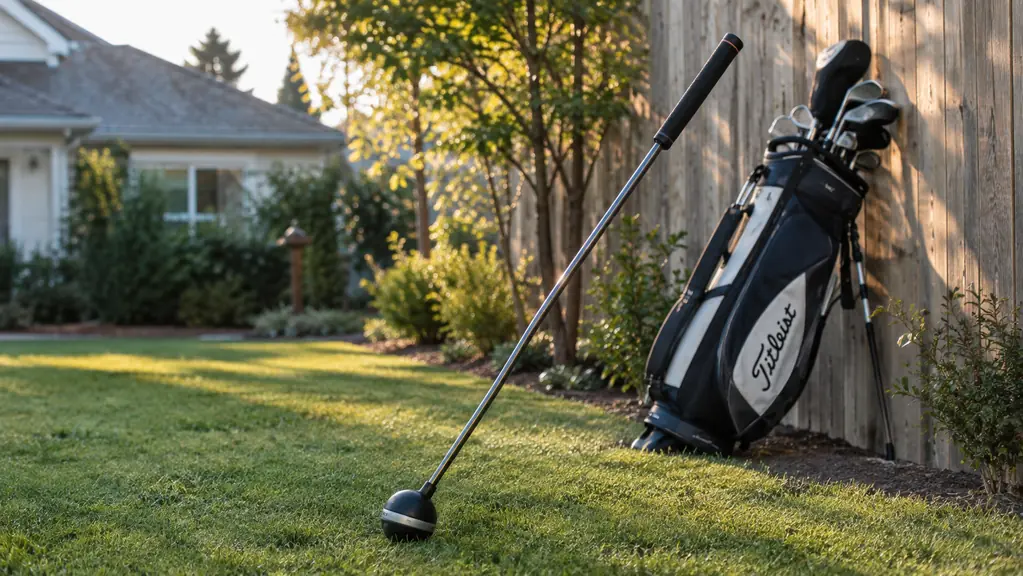
I bought the Orange Whip in March of this year, so I have had it about seven months. It leans by the back door, and on golf mornings it rides in the car with my clubs. On mornings when I play, I pull into the yard before I leave and make ten or fifteen slow swings. On the way to the course, I make a few more in the parking lot before I walk to the first tee. My wife Carol is the one who suggested I stop skipping my warm-up in the first place, so she does not get to tease me about it.
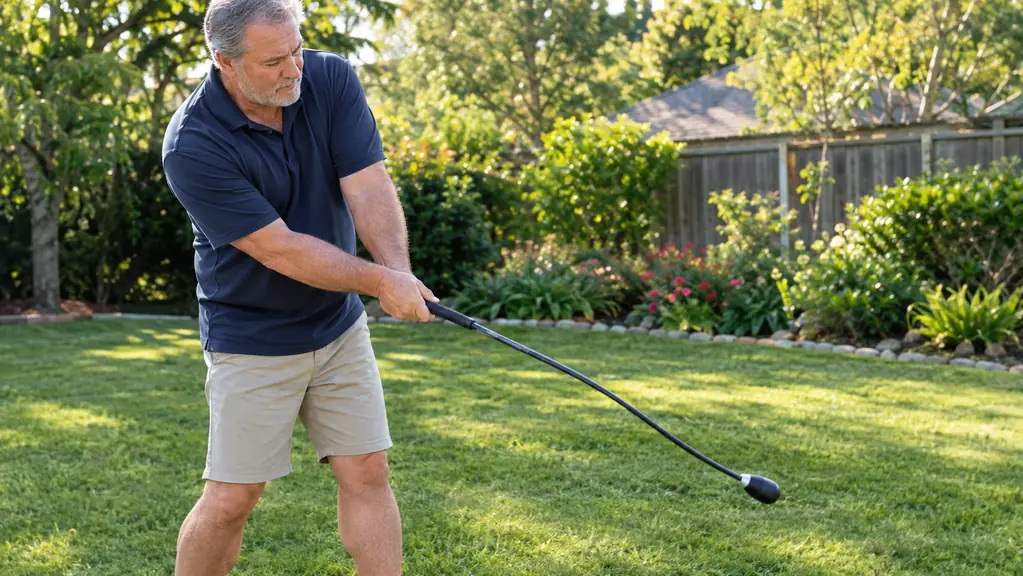
Here is what the Orange Whip actually feels like. The shaft flexes far more than a normal club. The weighted ball on the end lags behind, and the counterweight above the grip keeps the whole thing balanced. If you swing it the way you swing a driver, it feels clunky and the ball whips around in a way you cannot control. The only way to make it feel smooth is to slow your hands down and let the club do the work. That sounds simple, but for a 16-handicap golfer who spent years trying to swing harder, it is a genuine skill.
It does not come to the range with me; the backyard and the course parking lot are where it earns its keep. A few swings there reset my tempo before I hit a ball. I never use it indoors. For me it is a warm-up and a reset tool, not something I drill with for an hour. There have been days when I only had time for five swings, and even five swings helped. The trainer does not need a big block of time. It needs a few minutes, most days, and it rewards that better than any gadget I have owned.
A Typical Golf Week With It
I play three mornings a week, Tuesday, Thursday, and Saturday, at the same public course. Most weeks I also spend one extra evening at the range. That is a lot of golf for a 63-year-old with a stiff lower back, and the Orange Whip is part of how I manage it. On Tuesday and Thursday, the routine is the same. I grab the trainer from beside the back door, make ten slow swings in the yard, and then drive to the course. On Saturday, when the round is usually a little longer, I make fifteen swings, and I add a few more in the parking lot before I check in.
On the range evening, I use it differently. I hit a small bucket of balls, and between clubs I make three or four slow swings with my iron to reset my tempo. The idea is not to get tired. It is to remind my body, before every group of balls, what a smooth swing feels like. I have no way to measure whether it is working beyond how the ball flies and how my back feels the next morning. By both of those measures, it has been a good seven months.
What Nobody Tells You Before You Buy One
The first thing nobody tells you is that the Orange Whip is boring. There is no screen, no numbers, no app, no feedback other than feel. You will not learn your swing speed or your launch angle. You just swing, and the club tells you, in the only way it can, whether you rushed it. For people who like gadgets, that is a letdown. For people like me who needed to slow down, it is exactly the point.
The second thing is that it takes longer to work than you want it to. I noticed nothing in the first week. In the first month, I noticed that my first few swings on the range felt less hurried. By the third month, the smooth feeling started carrying over into my actual swing with a real club. That is a slow payoff, and it is the reason most people give up on it before it works.
The third thing is the one I almost did not want to admit. The Orange Whip will not fix a bad grip, a bad setup, or a swing path that sends the ball sideways. It works on tempo and rhythm, and that is all. If your swing has a mechanical problem, this club will happily let you swing that problem smoothly. It is not a swing coach. It is a metronome you can hold.
The fourth thing nobody tells you is that you will feel silly doing it, and that is fine. I am a retired shop teacher who has spent thirty-one years telling teenagers to try things that look awkward at first. The first time I swung the Orange Whip in the backyard, I checked to see if any neighbors were out. By the third week, I did not care. The feeling of a smooth swing is worth a little embarrassment, and nobody has ever said a word about it anyway.
What It Actually Does for a Stiff Lower Back
Now the part I get asked about most, because I am in my sixties and I have a lower back that does not like being twisted. About four years ago, after a long range session, I felt a strain that left me stiff in the morning and sore after rounds. I saw a physical therapist for six visits that winter, and the advice that stuck was simple: warm up before you swing hard, and do not twist from a cold start.
The Orange Whip fits into that routine. Ten slow swings in the backyard before I leave, a few more in the parking lot, and by the time I reach the first tee I am loose in a way I was not before. I want to be careful here, because I am not a doctor and this is not medical advice. The Orange Whip does not treat a bad back and it does not cure anything. What it does is give me a reason to make slow, full swings before I ever hit a ball, and that has made my mornings less stiff. If you have real pain, see a doctor or a physical therapist. That is the honest answer.
One more honest note. The evening after a round, I still get sore sometimes. The Orange Whip did not change that. What changed is that I no longer start the round already tight, and I do not make things worse with a fast, jerky swing off the first tee.
The Orange Whip does not fix your swing. It slows it down until the rest of your practice starts to work. That is a slower, more honest payoff than most reviews admit.
Where It Falls Short
For all the good things I can say about the Orange Whip, there are honest drawbacks. First, it is a one-trick pony. It trains tempo and nothing else. That is fine if you already have a decent swing and you just need to slow down, which is exactly my situation. It is not enough if you are rebuilding your swing from scratch.
Second, it only works if you use it consistently. A training aid that sits in the garage does nothing, and the Orange Whip is the kind of tool where the feeling fades if you stop. I have missed weeks when the weather turned and I did not want to stand in the yard. When I came back to it, the first few swings were as clunky as the very first day. That is not a flaw in the club, but it is a fact of life.
Third, it is not a substitute for a coach. I am a retired shop teacher, not a teaching pro, and I know the limits of what I can see in my own swing. The Orange Whip will not tell you what you are doing wrong. It will only tell you if you are doing it fast or slow. For a real mechanical problem, take a lesson. For tempo, this is the tool. I say that as someone who has taken his share of lessons over the years. A good pro can see what you cannot, and no training aid replaces that. But the pro cannot ride in the trunk of your car and remind you on Thursday morning to slow down. The Orange Whip does.
How It Fits With the Rest of My Routine
The Orange Whip is not the only thing I use, and I want to be honest about that. On the evenings after a round, I use a foam roller on the living-room rug, rolling my upper back, glutes, hips, and hamstrings. My physical therapist told me never to roll directly on my lower spine, so I do not. That roller handles the after-work. The Orange Whip handles the before-work. The two do different jobs, and I would not trade one for the other.
I also keep a pair of alignment sticks in my bag for the range, and I wear a lumbar support brace on cold mornings or when my back is already stiff, which works out to about one round in three. None of these things fixed my back, because nothing I own fixes a back. They are a routine. The Orange Whip is the part of the routine that made my swing slow down, and a slower swing is a swing that does not twist my lower back as hard.
What I Liked
- Slows your tempo down in a way that carries over to real clubs
- Genuinely useful as a warm-up before the first tee
- Simple and durable, nothing to charge, set up, or break
- Made in the USA and built to take daily swings
- Works anywhere there is room to swing
Where It Falls Short
- It is boring compared to gadgets that give you numbers
- Tempo is the only thing it trains
- The payoff takes weeks or months, not days
- It will not fix a bad grip, setup, or swing path
- You have to use it consistently or the feel fades
Who This Is For
Buy the Orange Whip if you already have a swing you mostly like, but you know you rush it. That is the exact profile. Weekend golfers, recreational players, people in their fifties and sixties who want to keep playing without their back seizing up on the first tee. If you are a 16-handicap player like me who hits the ball fine when you slow down, this is the tool that teaches you to slow down on purpose.
It is also for the golfer who knows they will actually use it. Ten swings in the backyard takes two minutes. That is a small enough ask that even a retired shop teacher with a stiff back can do it before his morning round.
One more thing. If you are a golfer who has already tried swinging harder and it did not work, which is most of us at some point, the Orange Whip is the opposite of that advice. It asks you to swing slower, not harder. For me, that was exactly the lesson I needed, and it is a lesson I still need most mornings.
Who Should Skip It
Skip the Orange Whip if you are rebuilding your swing from scratch, or if you need numbers and feedback to stay interested. It is also not the tool for you if you expect a training aid to fix a slice by itself. And if you have real back pain, do not buy a golf trainer instead of seeing a doctor. See the doctor first. The Orange Whip can wait.
And one more group should think twice: golfers who will only use it at the course. The Orange Whip works best when it becomes a habit, a few swings at home before you leave. If you know you will not do that, you are better off saving the trunk space. It is a tool for daily practice, not a gadget you pull out once a month.
My Honest Bottom Line
So is the Orange Whip worth it for a weekend golfer? That depends on what you expect. If you expect a training aid that will fix your slice or add distance or loosen a bad back by itself, you will be disappointed, and you should skip it. If you expect a well-made tool that will teach you to slow your tempo down, and you are willing to use it for a few minutes most days for a couple of months, it is the best money I have spent on my golf game in years.
I am not a teaching pro, and I do not pretend to be one. I am a 63-year-old weekend golfer with a 16 handicap and a lower back that complains. The Orange Whip is the one piece of gear that made my swing feel calmer, and a calmer swing is the only swing my back will tolerate these days. That is the honest review. It is not the flashiest tool in the garage, but seven months in, it is the one I reach for first.
Seven months in, I would buy the Orange Whip again
It does one job and it does it well, and it only works if you use it. If your swing has gotten fast and jerky, this is where I would start.
Amazon Check Today's Price on Amazon →