

I felt the first twinge of my back strain about four years ago after a long range session, and I have been managing it ever since. It shows up as stiffness in the morning and a dull ache the evening after a round. I saw a physical therapist for six visits that winter, and the best thing she taught me was to stop skipping my warm-up. The second best thing I did for my back was buying the Sparthos back brace in May of 2025 and actually wearing it on the course.
I am 63, I play three times a week at a public course outside Cleveland, and I walk when the weather allows. My handicap sits around 16, which is a polite way of saying I am not a power player. I am a guy whose lower back does not like being twisted, and a full round of golf involves an awful lot of twisting. My wife Carol is the one who suggested I stop skipping my warm-up, and she was right. The Sparthos is the piece of gear I added after the warm-up became a habit. This is my honest account of wearing it through a full season of rounds, roughly one round in three, and what it did and did not do.
The Quick Verdict
The Sparthos is a lumbar support belt that does what a belt can do. It supports, it reminds me to stay braced, and it takes the edge off stiff mornings. It will not fix a back, and it should not be the only thing you do about one. But worn one round in three, it earns its place in the trunk.
Amazon Check Today's Price →The honest case for a back brace on the course
I wore the Sparthos on roughly one round in three across a full season. It supported my lower back, stayed put through my swing, and reminded me to stay braced. It also taught me what a brace will not do. If that sounds like an honest trade, it is worth a closer look.
Amazon Check Today's Price on Amazon →How I've Used It
I bought the Sparthos in May of 2025, so I have had it for about seventeen months now. It lives in my golf bag, and it only goes on the course. I do not wear it around the house, and I have never worn it to sleep. For me it is a tool for the round, not a lifestyle change.
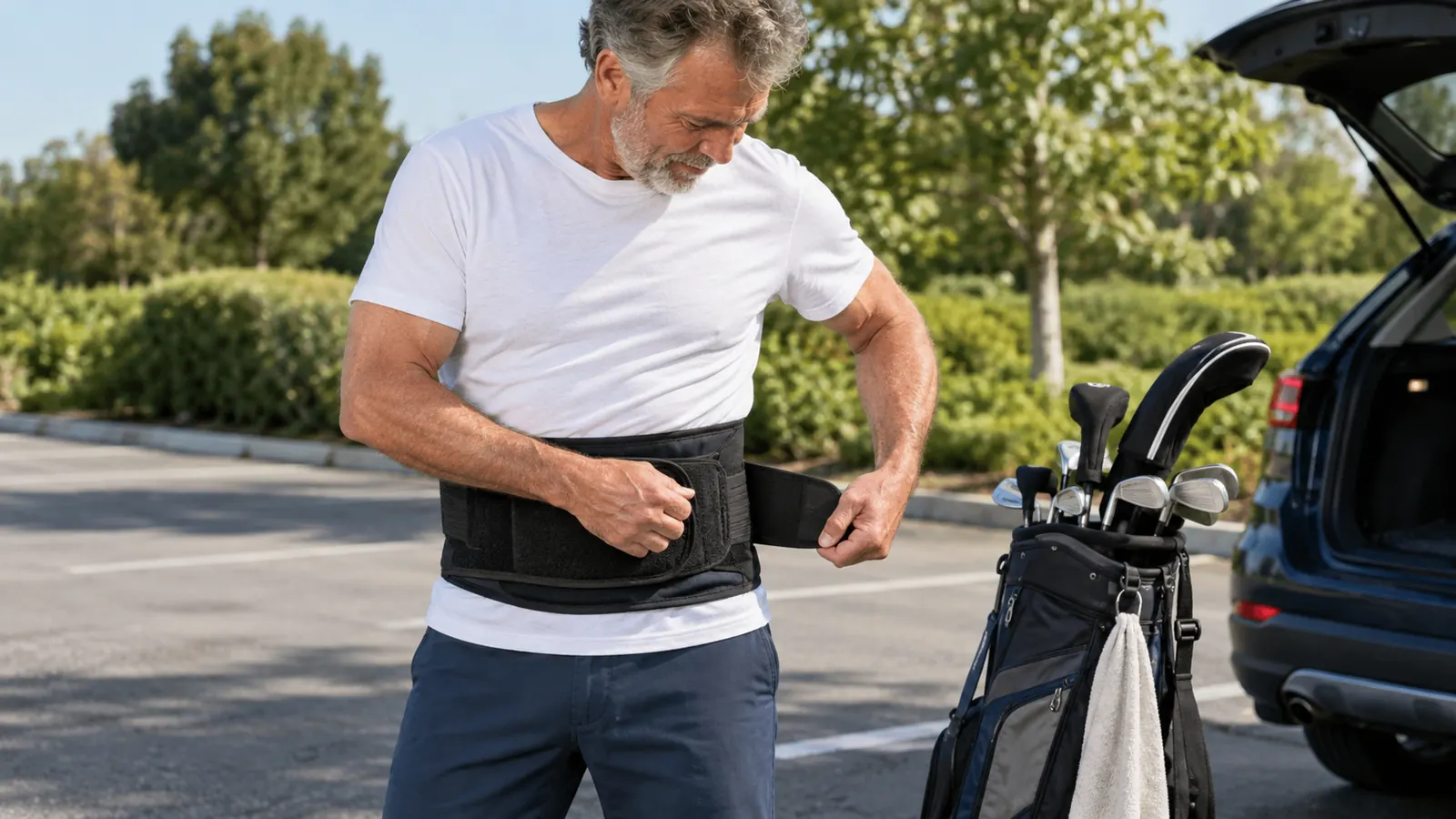
I wear it over a thin undershirt on cold mornings and on days when my back is already stiff. That works out to roughly one round in three. The brace is a lumbar support belt with a padded lower-back panel, adjustable side straps, and breathable mesh. I put it on at the car, position the padded panel over my lower back, and pull the side straps snug. Not tight. Snug. It takes about thirty seconds.
Early on I made the mistake of pulling it too tight. I learned that the brace works better as a reminder than a corset. When it is snug, it reminds me to stay braced through my setup and my swing. When it is too tight, it just makes me think about the brace. The mesh matters more than I expected. On a humid July round, the breathable panels kept me from feeling like I was wearing a rubber tire.
I keep it in the trunk rather than the house because the trunk is where I am when I need it. The decision to wear it happens at the car, before the first tee, and that is exactly where the brace lives. If it lived in a drawer at home, it would stay in the drawer. That may sound like a small organizational detail, but it is the difference between a tool that gets used and a tool that gets owned.
What the Brace Actually Does
I want to be precise here because there is a lot of nonsense in the back-pain aisle. The Sparthos does not fix anything. It does not straighten your spine, loosen a tight muscle, or undo years of bad range habits. It is also not a medical device in the sense that it treats anything. The company sells it as a support for people dealing with lower back discomfort, and the box does not pretend to be a prescription. I appreciate that honesty, because the aisle is full of products that promise more than a belt can deliver. What the Sparthos does is support, and support turns out to be useful.
The padded lower-back panel gives me something firm to brace against. When I set up over the ball, I can feel the panel against my lower back, and it encourages me to keep a neutral spine instead of rounding into the shot. It is a physical reminder, the same way a coach taps your shoulder. Over the course of a round, that reminder adds up.
The side straps are easy to adjust, which matters because my back feels different from hole to hole. On a stiff morning I can snug them up a little more between the third and fourth holes. On a day when I am moving well, I can loosen them at the turn. Being able to adjust the brace without taking it off is half the reason it actually gets used.
The mesh keeps it wearable. I have worn it on cool October mornings and hot July afternoons, and it has never made me feel overheated the way I expected a back brace to. That sounds like a small thing, but a brace you are willing to wear is a brace that does its job.
What a Season Taught Me
This is the honest section. The brace did not change my golf game. I did not gain yardage, and I did not suddenly swing pain free. What it did was make the round more comfortable and keep me from making things worse.
The mornings are the hardest part of my back. I wake up stiff, and the first few holes used to be a gamble. On days when I wear the Sparthos, the stiffness settles down faster. I think it is a combination of the support and the warmth. Either way, I notice the difference by the fourth or fifth tee. The evenings are the second hardest part. After a round, my back tends to ache while I am sitting in the car or on the couch. The brace does not do much for that, and I do not expect it to. I take it off at the car, and the evening routine belongs to my foam roller on the living room rug. The brace and the roller are two different tools for two different jobs, and I think it is a mistake to ask either one to do the other's work.
It also taught me that a brace is not a substitute for a warm-up. The stretch of the season when I leaned on the brace without my usual warm-up was the stretch my back complained the most. These days I do a few minutes of easy swings with my Orange Whip in the backyard before I leave, and a few more in the parking lot before I tee off. The brace is part of the routine, not the whole routine.
Seventeen months in, the Sparthos still holds its shape, and the straps still cinch down the way they did the first morning I wore it. That is the specific proof that matters to me. I have owned belts that stretched out and went soft within a season. This one has not.
Seventeen months in, the Sparthos still holds its shape, and the straps still cinch down the way they did the first morning I wore it.
Alternatives I Considered
I have only ever owned the Sparthos, so I cannot give you a long-term review of the alternatives. What I can tell you is what I learned from a friend's Mueller lumbar brace at the range. The Mueller is a solid, no-nonsense brace, and I can see why it has a following. It felt a little stiffer and a little less breathable to me, and the Sparthos was more comfortable to wear for a four-hour round. That is a short impression, not a verdict, but it is an honest one.
The other thing I compared it against was doing nothing, which is what I did for the first couple of years after my back strain. That comparison is the easiest one to call. Wearing the brace one round in three beat doing nothing, mostly because it kept me from rounding into my shots on the days my back felt stiff.
There are a handful of reasons a lumbar brace earns a place in a golfer's bag, and most of them are the small ones. The reminder on the tenth tee. The warmth on a cold first hole. The support on the days your back woke up angry. The Sparthos handles all of those without making itself the center of attention.
I also looked at the lighter, sleeve-style supports that some guys wear. I handled one at a golf store and decided it was not for me. It did not have the same firm panel against my lower back, and the firm panel is the part I actually feel working. The Sparthos gives me that panel without feeling like I am wearing a cast.

The Small Details That Matter
A few details are worth mentioning because they decide whether a brace gets used. The Sparthos stays put through a full swing. I never had to yank it back into place mid-round, and I have worn it on days when I was walking the course with a push cart. It does not ride up when you bend to tee up a ball or pick a ball out of the cup.
It is also easy to keep clean. A damp cloth takes care of the dirt from the parking lot and the cart path, and it dries fast. Small as that sounds, it is the difference between a brace that lives in the trunk and one that ends up in a drawer.
One more thing I appreciate: it does not announce itself. Under a light windbreaker on a cold morning, nobody can tell you are wearing it. Some guys do not care about that. I do, mostly because I would rather talk about the round than about my back.
The One Thing I Would Tell a Friend
If a friend asked me whether to buy the Sparthos, my answer would be yes, with a condition. Buy it if you are willing to wear it for a month before you judge it. The first round or two, the brace feels like something to notice. By the fourth or fifth round, it feels like part of the routine, and that is when you can actually tell whether it is helping.
The other thing I would tell him is to keep the rest of the routine. Warm up before the round, stretch the evenings after, and see someone if the pain is real. A brace is a good tool, but it is a tool. It works best in a toolbox that has the other things in it too.
What I Liked
- Padded panel sits right where a golfer needs it, over the lower back
- Side straps adjust in seconds, even between holes
- Breathable mesh means I can wear it in July without overheating
- Works as a physical reminder to stay braced through the swing
- Held its shape and tension for seventeen months so far
- Easy to throw on over a thin undershirt at the car
Where It Falls Short
- It supports, but it does not fix a back, and no brace should pretend otherwise
- Took a few rounds to learn the right tightness, not too loose, not a corset
- Warmest on the most humid days, mesh or no mesh
- Only helps if you actually put it on, which is why I keep it in the trunk
- Not a substitute for a warm-up, a foam roller, or a doctor when pain is real
Who This Is For
This is for the golfer whose back gets stiff, not the golfer whose back is injured. If you have a diagnosed problem, a doctor or physical therapist should be the one telling you what to do. I saw a physical therapist for six visits after my strain, and that is the best advice I can pass along. A brace is a complement to that kind of care, not a replacement for it.
If you are like me, a 63-year-old recreational player with a lower back that complains on cold mornings and after long rounds, the Sparthos is a reasonable tool. It is for the person who will wear it one round in three and adjust it at the turn. It is for the person who understands that a brace is part of a routine, not the whole routine.
Who Should Skip It
Skip it if you are looking for a cure, because no belt fixes a back, and buying this expecting it to will only disappoint you. Skip it if you are in real pain, because that is a conversation for a doctor, not an online order.
And skip it if you are not going to wear it. The Sparthos only does its job when it is on your back, which means it has to go on your back. That sounds like obvious advice, but you would be surprised how many braces sit in trunks. If you already know you will not take the thirty seconds to put it on at the car, save your money for something you will actually use.
One round in three, for a full season
The Sparthos back brace earned a permanent spot in my trunk because it supports, it reminds, and it has held up for seventeen months. It will not fix your back, and it should not be the only thing you do about one. But for a stiff-morning golfer who will actually wear it, it is an honest tool. Check today's price and decide if it belongs in your bag.
Amazon Check Today's Price on Amazon →