

If you are a golfer with a lower back that complains, you have probably stood in front of the brace shelf the same way I did: wondering whether a lumbar support belt is worth wearing on the course, and which one to trust. I am Russ, 63, a 16-handicap recreational golfer outside Cleveland. I have worn the Sparthos back brace for about 17 months, roughly one round in three, and I have borrowed a friend's Mueller lumbar brace for one range session. This is the honest comparison I wished I had found before I bought mine, written the way I would explain it to a buddy on the first tee.
The short answer: the Sparthos is the one I reach for on a cold morning when my back is already stiff, and the Mueller is the one I would consider if I wanted a firmer, more athletic feel for a short round. Neither one fixes a bad back. Both of them do the same basic job, which is reminding you to stay braced and taking a little load off the lower back while you swing. The differences are in the details, and the details are what decide whether a brace actually gets used. I have worn the Sparthos on the course since May of 2025, and I wore a friend's Mueller for one range session. What follows is what I noticed, not what a spec sheet says.
The brace I have worn for 17 months of golf
If you want the lumbar support belt that actually made it into my bag and stayed there, the Sparthos is the one. It is the brace I reach for on cold mornings and stiff days, and the one I forget I am wearing by the third hole.
Amazon Check Today's Price on Amazon →How I Compared Them
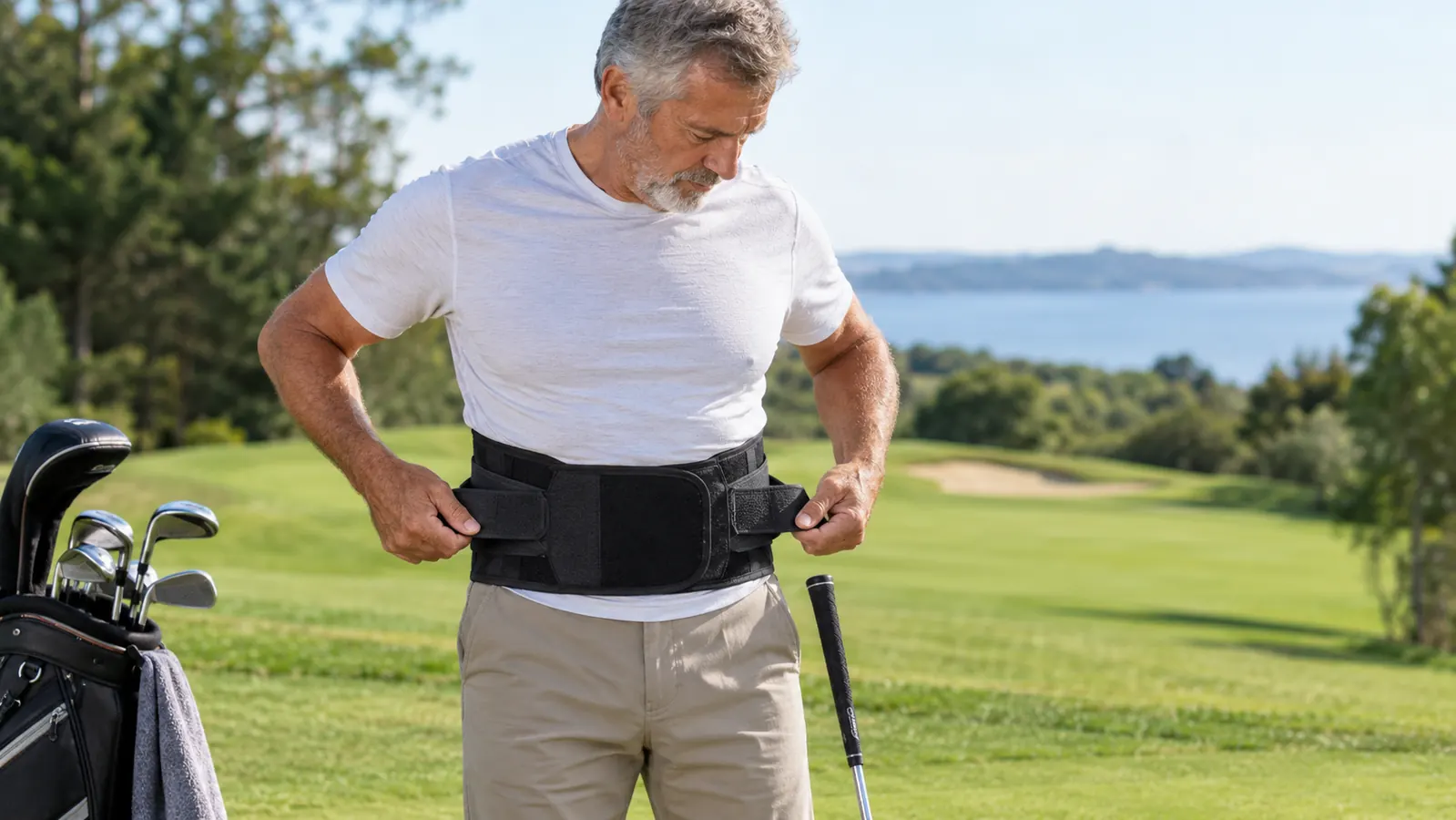
I have owned the Sparthos back brace since May 2025, so I have now worn it through a full summer, a fall, and into a second season. It is a lumbar support belt with a padded lower-back panel, adjustable side straps, and breathable mesh. I wear it over a thin undershirt on cold mornings and on days my back is already stiff, which works out to about one round in three. I never wear it while sleeping, and I save it for the course. I remember the round that made it a habit: a cold morning that first autumn, about 46 degrees with dew still on the fairways. My back was stiff from a long range session the night before, and I remember standing in the parking lot, adjusting the side straps, and thinking this had better do something. By the second hole, I had stopped thinking about it, and that turned out to be the whole point of a brace. I also learned that a thin cotton undershirt under the brace keeps the straps sitting right, and I have done it that way ever since.
Before the Sparthos, my only plan for a stiff back was a longer warm-up and hoping for the best. I would stand on the first tee and try to ease into my swing, and some mornings that worked fine. Some mornings it did not, and I would spend the front nine swinging at about 70 percent while my back reminded me why I should have stretched more the night before. That is why I finally ordered a brace instead of just thinking about it. The Mueller lumbar brace I have only handled briefly. A friend at the course, who has the same kind of lower-back trouble, let me try his for a few swings on the practice green and one full range session on a Friday evening in October 2025. We split a large bucket, and he handed it to me the way you hand over a good club, with a little pride. He has the same trouble I do, so we compare notes on the first tee whenever we get paired together. That is enough to feel the difference in materials and fit, but I want to be clear that I am not giving you a long-term opinion of the Mueller. I am giving you what I felt in the time I had it, and what I know about how each one behaves on a golf swing.
My back history matters here. About four years ago, in the autumn of 2022, I felt a lower-back strain after a long range session, and it left me stiff in the morning and sore the evening after a round. I saw a physical therapist for six visits that winter. No surgery, no scans, no prescription. The therapist's advice was simple: keep moving, warm up properly, and use support when you need it. She also told me not to just sit still and wait for it to heal, because backs get worse with too much rest. That is the lens I am using for this comparison. I am not a doctor and I do not play one in these articles. If you have real or worsening pain, please see a doctor or physical therapist. A brace is a tool, not a treatment, and it works best when it is part of a routine that includes a warm-up and some stretching.
| Sparthos Back Brace | Mueller Lumbar Brace | |
|---|---|---|
| Support feel | Padded panel that supports without squeezing; easy to forget mid-round | Firmer, more athletic compression that you feel with every swing |
| Comfort for a 4-hour round | Breathable mesh, worn over a thin undershirt, no chafing by the 18th | Noticeably warmer and stiffer; fine for a short session, less inviting for a full round |
| Ease of adjusting on the course | Side straps are easy to reach and tweak between shots | Adjustment is doable but the firmer material makes it a two-hand job |
| Warmth on cold mornings | Adds a useful layer of warmth over an undershirt | Warmer still, which helps in cold weather but gets stuffy by midday |
| Best for | A golfer who wants support they can forget about for a full round | A golfer who wants maximum feedback and a firmer brace for shorter sessions |
Where Sparthos Wins
The Sparthos wins on the things that matter over 18 holes. The padded lower-back panel sits where I need it, and the adjustable side straps let me set the tension once and leave it alone. My usual approach is to tighten the straps until I can feel the pad press against my lower back, then back it off just a little so I can breathe and swing freely. That setting usually holds for the whole round. The breathable mesh makes a real difference on a warm June morning. I have worn it for full rounds in the summer heat and never felt like I was cooking inside it. The round that sold me was a stiff morning that first summer when I walked all 18 holes in shorts and a light shirt, carrying my bag the way I do when the weather is nice. The pad stays put even on a hard follow-through, which I noticed during a round when I really went after a drive. By the third hole, I forgot it was there, and that is exactly what I want from a brace. I want the support without the constant reminder that I am wearing one.
It also wins on the little practical details. The side straps are easy to reach and tweak between shots, which matters when you are standing on a tee box and your back is telling you it wants a little more support. On a cold morning I will give the straps a little more tension before I tee off, and on the back nine, if I am feeling loose, I can back them off without taking the brace off. That kind of fine adjustment is harder with the Mueller, where the firmer material makes any change a two-hand job. And because it is comfortable enough to forget, I actually wear it, which is the whole test. A brace that sits in the bag does nothing. The Sparthos has been in my rotation for 17 months, on cold or stiff golf mornings and the odd humid afternoon, and it has never once made me want to take it off mid-round. That is the strongest thing I can say about it.
Where Mueller Wins
I have to give the Mueller its due. The firmer, more athletic compression gives you more feedback with every swing. You feel it working, and for a golfer who wants that constant reminder to stay braced, that is a real advantage. On that Friday evening range session, I could feel the difference on the very first swing. The Mueller holds you more firmly, and there is no mistaking that it is there. If you are the kind of golfer who wants to know the brace is doing its job on every shot, that feedback is valuable. On a cold morning when I wanted maximum support and did not mind feeling wrapped, the Mueller felt like the more serious piece of equipment. It also runs warmer, which is a benefit if you are teeing off in 40-degree weather. My friend who owns it plays early on weekend mornings in the fall, and he swears by it for exactly that reason. He wants to feel braced from the first tee, and the Mueller delivers that feeling without any question. His brace has seen a few seasons of use, and it still holds its compression, which says something about the materials.
Where the Mueller lost me was the long game. Over that same range session, by the time I was about 50 balls into the bucket, the firmer material started to feel restrictive. I noticed myself thinking about the brace instead of thinking about my swing, and that is a bad sign for anything you plan to wear for four hours. I could also tell it would get stuffy by the back nine on a warm day, and I would not want to be walking 18 holes in July with that much compression around my midsection. For a short round or a practice session where you want maximum feedback, I can see the appeal. My friend mostly plays nine holes on weekend mornings, and for that kind of round, the firmer feel is probably a fair trade. For a 4-hour round in the summer, I would pick the Sparthos every time. When the range session ended, I handed it back and told my friend I would stick with my own brace. He just nodded, the way you nod when you have heard that before. That is not a knock on the Mueller. It is a different tool for a different job, and if my rounds were shorter, I might feel differently about it.
The brace that made it through a full season
If you are looking for a lumbar support belt you can actually wear for a full round, the Sparthos is the one I kept reaching for. Comfortable, breathable, and easy to adjust on the course.
Amazon Check Today's Price on Amazon →
Who Should Buy Which
Buy the Sparthos if you want a lumbar support belt you can forget about. If you play full rounds, walk when the weather allows, and need something that supports without squeezing, the Sparthos is the brace I would recommend. It is the one I have worn for 17 months, and it is the one I reach for on a cold morning when my back is already stiff. On a stiff morning, I put it on over a thin undershirt in the parking lot, tighten the side straps once, and do not think about it again until I take it off at the car after the round. The one stiff morning I forgot to put it on, a damp Thursday in April, I felt the difference by the fifth hole. That is the experience I wanted when I ordered it in May 2025, and it is the experience I have gotten. It has also held up well. Seventeen months of being pulled on and off, stuffed into my golf bag, and left in the car on warm days, and the straps still hold their adjustment and the mesh has not frayed or stretched out of shape.
Consider the Mueller if you want a firmer, more athletic feel and you mostly play short rounds or practice sessions. If you like feeling the brace working on every swing, and you do not mind a warmer, more restrictive fit, the Mueller is worth a look. My friend wears his for nine-hole rounds on weekend mornings and says it keeps his back from tightening up on the drive home. I believe him, because the firmer compression is exactly the kind of thing that would help on a short, cold outing. But if you are like me, a 63-year-old who wants to play three times a week without his back complaining, the Sparthos is the one that will actually make it into your bag. It made it into mine in May 2025, and it has not spent a season sitting in the garage yet. That is the difference between a brace you buy and a brace you use. And if you are still deciding, my advice is to think about how long your rounds actually are, because that is the detail that settled it for me.
A brace that sits in the bag does nothing. The Sparthos has been in my rotation for 17 months, and that is the strongest thing I can say about it.
The Bottom Line
Both of these braces do the same basic job: they support your lower back and remind you to stay braced through the swing. The Sparthos does it in a way you can forget about, which is why it is the one I wear. The Mueller does it with more feedback and a firmer feel, which some golfers will prefer. Neither one fixes a bad back, and neither one should be your first stop if you are in real pain. My physical therapist's advice still holds: keep moving, warm up properly, and use support when you need it. The brace is the support part, not the whole plan. For me, the whole plan is a warm-up with the Orange Whip in the parking lot before the first tee, the Sparthos over an undershirt on stiff days, and the foam roller on the living-room rug after the round. The brace is one piece of that routine, but it is the piece that got me through a full season without skipping a Saturday round. I have told Carol more than once that the brace is swing insurance, and she rolls her eyes, but she is the one who reminds me to grab it on cold mornings. If you are looking for support on the course, the Sparthos is the brace I would buy again.
Start your next round feeling more supported
The Sparthos back brace is the one I have worn for 17 months of golf. If you want a lumbar support belt that is comfortable enough to forget and supportive enough to notice, this is the one to try.
Amazon Check Today's Price on Amazon →