

If you have a lower back that gets stiff after a round of golf, you have probably stood in the sporting goods aisle staring at a wall of foam rollers and wondered what the difference actually is. I stood there myself in January of 2025, on a morning when my back had been stiff for a few days after a cold, wet Saturday round. I had a smooth, basic foam roller in one hand and the TriggerPoint GRID in the other, trying to justify the difference in price. Twenty-one months later, I can tell you exactly what the texture does, because I have rolled out my upper back, glutes, hips and hamstrings on the living room rug most evenings since.
Before that trip to the store, my approach to a stiff back was simple: I ignored it. I would take a couple of slow walks, skip the range for a week, and hope the next round felt better. It never really did. About four years ago, after a long range session, the stiffness turned into something sharper, and that is what finally sent me to a physical therapist. She gave me six visits that winter, and one of the things she showed me was how to use a foam roller. Hers was a plain, smooth cylinder, and it was fine for learning the motion. But it was not fine for actually reaching the spots that needed work, because the foam just gave way under my weight. So I knew what I was looking for when I walked into that store: something that would not give way. I did not know if the TriggerPoint GRID was it. I only knew I was tired of the routine where I ignored my back until it forced the issue.
The short answer: yes, the texture matters, but not the way the marketing makes it sound. The TriggerPoint GRID is not magic. It is a firmer, multi-density surface that lets you work a specific muscle with less padding getting in the way. A basic smooth roller is softer and more forgiving, which sounds like a feature until you are trying to get at a knot in your glute and the foam just squishes around it. For a 63-year-old golfer whose back complains after 18 holes, the TriggerPoint GRID has earned its spot on my rug. Here is the honest comparison.
| TriggerPoint GRID | Basic Foam Roller | |
|---|---|---|
| Surface | Firm multi-density grid that digs into a specific spot without flattening out | Smooth, soft foam that feels gentle but squishes away from a knot |
| Pressure control | You can ease into a spot and hold it, or shift your weight to back off | Hard to get real pressure on a specific muscle without stacking body weight awkwardly |
| Comfort for beginners | Firm enough that you need to start slow, especially on the upper back | More forgiving for someone who has never rolled before |
| Durability | Hollow core and dense surface, still feels the same after 21 months of regular use | Softer foam that gives more under body weight |
| Best for | A golfer who wants to work a specific area after a round | Someone who wants a gentle introduction to rolling |
Where the TriggerPoint GRID Wins
The biggest difference shows up in the glutes and hips, which is where most of my back trouble actually starts. On a smooth roller, when I put my weight on a tight spot, the foam gives. It spreads the pressure across a wide area, which feels fine, but it does not actually change anything. On the TriggerPoint GRID, the firm, multi-density surface holds its shape, and the grid pattern catches the muscle so I can hold steady pressure exactly where I need it. Same exercise, different result. My physical therapist told me years ago that the glutes and hamstrings take a lot of the load for a lower back, and the TriggerPoint GRID is the first roller I have owned that lets me work those areas the way she described. One evening stands out. After a round and a long drive home, my left glute was so tight that getting out of the car took real care. I set up on the living room rug, worked the upper back first, then spent a few minutes on the left side. I found the exact spot, a knot about the size of a walnut, and held my weight there for maybe thirty seconds. When I stood up, the difference was noticeable. Not cured, but noticeably looser, and the next morning I did not have to ease into the day the way I usually do. The upper back is where the grid texture is most noticeable at first. The first few times I rolled my upper back, I had to remind myself to breathe. Now it is the part of the routine I look forward to, because it loosens the tightness between my shoulder blades that builds up over a season of swinging. I never roll directly on my lower spine. That was my physical therapist's rule, and I have kept it.
The other win is durability. I bought the TriggerPoint GRID in January 2025, and it has been used most evenings for 21 months, plus a few minutes most mornings when my back wakes up stiff. It still feels exactly as firm as the day I brought it home. I know what soft foam does over time because I owned a thin hitting mat that flattened out after two winters in the garage, and I have handled a friend's basic smooth roller at the range that looked well used. The TriggerPoint GRID's hollow core and dense surface have held up without a flat spot or a soft section. The 13-inch length is part of why it works for me. It is short enough to work one side of the body at a time, which is exactly what you want when only the left glute is complaining. A longer roller spreads you out; this one keeps the pressure where you put it. That matters when a roller is part of a routine rather than a novelty. Most evenings I spend about ten minutes on the living room rug: a slow roll down the upper back, then the glutes and hips on each side, then the hamstrings. On a Saturday after 18 holes, I add extra time on the hips because that is where the stiffness settles. The roller has taken that use for 21 months and still feels the same, and I cannot say that about any other piece of foam I have owned.
The roller that still feels new after 21 months of evening use
If you want a roller that lets you work a specific spot and does not soften into a squishy tube, the TriggerPoint GRID is the one I reach for after every round. Check today's price on Amazon and see if it fits your routine.
Amazon Check Today's Price on Amazon →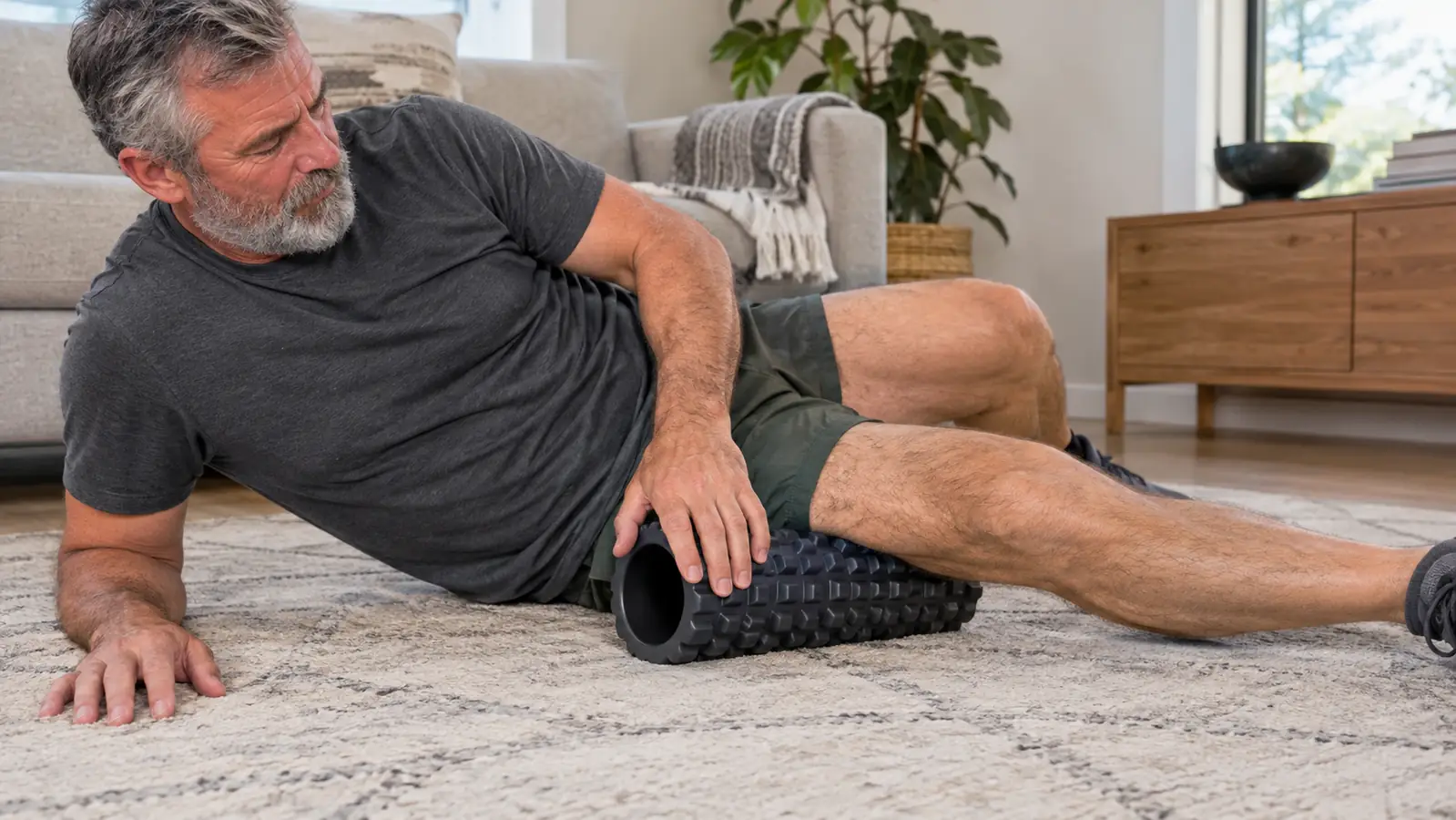
Where the Basic Foam Roller Wins
I am not going to pretend the basic roller has no place. It does. For someone who has never rolled before, or someone with a lot of muscle tension who finds firm pressure uncomfortable, a smooth, softer roller is a gentler place to start. The one at the physical therapist's office was the first roller I ever touched, back in the winter after my back first acted up. It was a plain, smooth cylinder, and it served its purpose: it taught me the motion without overwhelming me. There is real value in that. When you are in your sixties and someone tells you to lie on the floor and roll a hard cylinder under your back, the last thing you need is a surface that makes you brace. The smooth roller lets you learn the movement, figure out how to breathe through it, and build the habit. The TriggerPoint GRID is a better tool for the long run, but it is a harsher teacher on day one. A friend I play with sometimes has a smooth roller that stays in his trunk, and he uses it on the bench at the range before he hits. He is a few years younger than me, and his back does not complain the way mine does. For him, a smooth roller is plenty, because he is not chasing a specific knot. He is just loosening up. Different job, different tool. I am not saying the basic roller is a waste of money. It is not. It is a perfectly good introduction to a habit that can save you a lot of morning stiffness. It just is not the tool I reach for anymore.
The basic roller also wins on price, and I am not going to pretend otherwise. You can find a smooth foam roller for a fraction of what the TriggerPoint GRID costs, and if all you want is a gentle roll after a long walk, it will do the job. The catch is that it will not do the deeper, more specific work that the TriggerPoint GRID does. For me, the difference in price was worth it because I use the thing almost every day. For someone who plans to roll once a month, the basic roller is the sensible buy. It is a tool, and the right tool depends on the job. I would add one caution. If you are buying the basic roller because you are not sure you will stick with the routine, that is a fair reason, and I respect it. But if you are buying it because you think the texture makes no difference at all, you are guessing wrong. I thought the same thing for the first couple of years after my back acted up. The morning I finally stood in that aisle and pressed my palm into the TriggerPoint GRID's surface, I understood the difference in about ten seconds. The texture is the whole point of the tool.
The TriggerPoint GRID does not fix my back. Nothing does. It just makes the stiffness less, and it has done that consistently for 21 months.

Who Should Buy Which
Buy the TriggerPoint GRID if you are like me: a golfer in your sixties whose back gets stiff after a round, who wants to work a specific area, and who will actually use the roller most days. The firm surface takes a little getting used to, but it lets you find the spot that needs work and hold pressure there. It has held up through 21 months of evening use without softening, and it is the tool I reach for when my glutes and hamstrings are tight the morning after a round. I play three mornings a week, Tuesday, Thursday and Saturday, and I walk when the weather allows. Most evenings after a round, the roller comes out on the living room rug while the clubs go back in the garage. Sunday afternoons are pickleball with friends, and the roller gets used that evening too, because a couple of hours of pickleball puts the same kind of strain on the hips. It is just part of the routine now. If you can see yourself building that same habit, the TriggerPoint GRID is worth the extra money.
Buy a basic foam roller if you are new to rolling, if firm pressure is genuinely uncomfortable, or if you are not sure you will use it regularly. It is gentler, cheaper, and perfectly fine for a general roll. Just know that it will not do the deeper, more specific work that the TriggerPoint GRID does. And be honest with yourself about which category you are in, because a roller only helps if it actually gets used. The one that sits in the closet is the one that costs the most, whatever you paid for it. If you are dealing with real or worsening pain, do what I did about four years ago and see a doctor or physical therapist first. A roller is a tool, not a treatment. It made my mornings easier, but it did not fix anything, and I would not want anyone to read this and expect it to.
Start with the roller that still works after 21 months
The TriggerPoint GRID has been part of my evening routine since January 2025, and it still feels as firm as day one. If that sounds like the tool you need, check today's price on Amazon.
Amazon Check Today's Price on Amazon →