

I am 63 years old, I play golf three times a week, and my lower back has been stiff for about four years now. It started after a long range session in the fall of 2022, I saw a physical therapist for six visits that winter, and I have managed it ever since. Some mornings I wake up and my back just feels like it has been welded together. If that sounds familiar, you already know the problem with golf: the whole swing is a twist, and a twist is exactly what a strained lower back does not want.
I am not a doctor and I am not a teaching pro. I am a retired shop teacher who likes to walk 18 holes on a Tuesday morning. What I have figured out, after a lot of trial and error, is a routine that gets me to the first tee without my back seizing up, and gets me through the back nine without counting the steps to the cart. The Sparthos back brace is part of that routine, and it is the part people ask me about most, so here is the whole system, step by step.
The brace I reach for on stiff mornings
The Sparthos back brace is the lumbar support belt I have worn for over a year on the mornings my back is already talking to me. It has a padded lower-back panel, adjustable side straps, and breathable mesh, and it gives me enough support to swing without thinking about my back on every shot. It does not fix anything, but it does not have to. It just needs to get me through 18 holes.
Amazon Check Today's Price on Amazon →Step 1: Loosen up before you leave the house
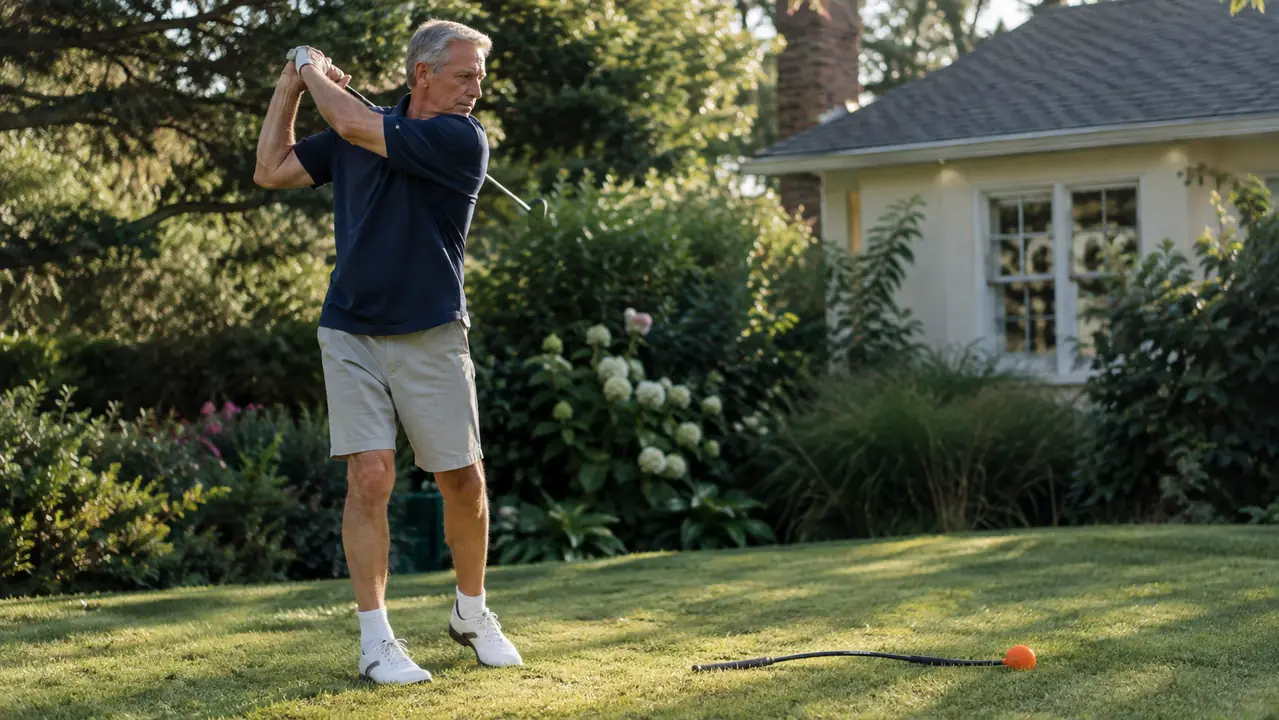
The worst thing I can do on a golf morning is go from bed to car to cart and then try to swing. My back needs about twenty minutes of movement before it will cooperate. Most mornings I play, I take the Orange Whip swing trainer into the backyard and make maybe thirty slow swings. The flexible shaft rewards a smooth tempo and it feels clunky if you rush it, which is exactly the reminder I need at seven in the morning. I bought the Orange Whip back in March of this year, and within the first week I noticed I was not starting my rounds with that first-tee lurch.
If the weather is bad, I swap the Orange Whip for a few slow swings with a short iron in the garage on the GoSports Elite hitting mat, which I bought last November for winter practice. It has a cushioned base, so I can hit real clubs off a tee or off the turf without punishing my back on a concrete floor. Last January, when there was snow on the ground for three straight weeks, that mat is the reason I could still take a full swing every few days. The point of this step is not practice. The point is to remind my lower back that it is allowed to rotate today, slowly and on my terms.
I also spend a few minutes on the living-room rug with the TriggerPoint foam roller before I leave. I roll my upper back, glutes, hips and hamstrings, and I never roll directly on my lower spine, because my physical therapist told me not to. That takes another five minutes and it makes a real difference in how the first tee feels. On mornings when I am really stiff, I will spend a little extra time on my glutes, because I have found that when those loosen up, my lower back follows.
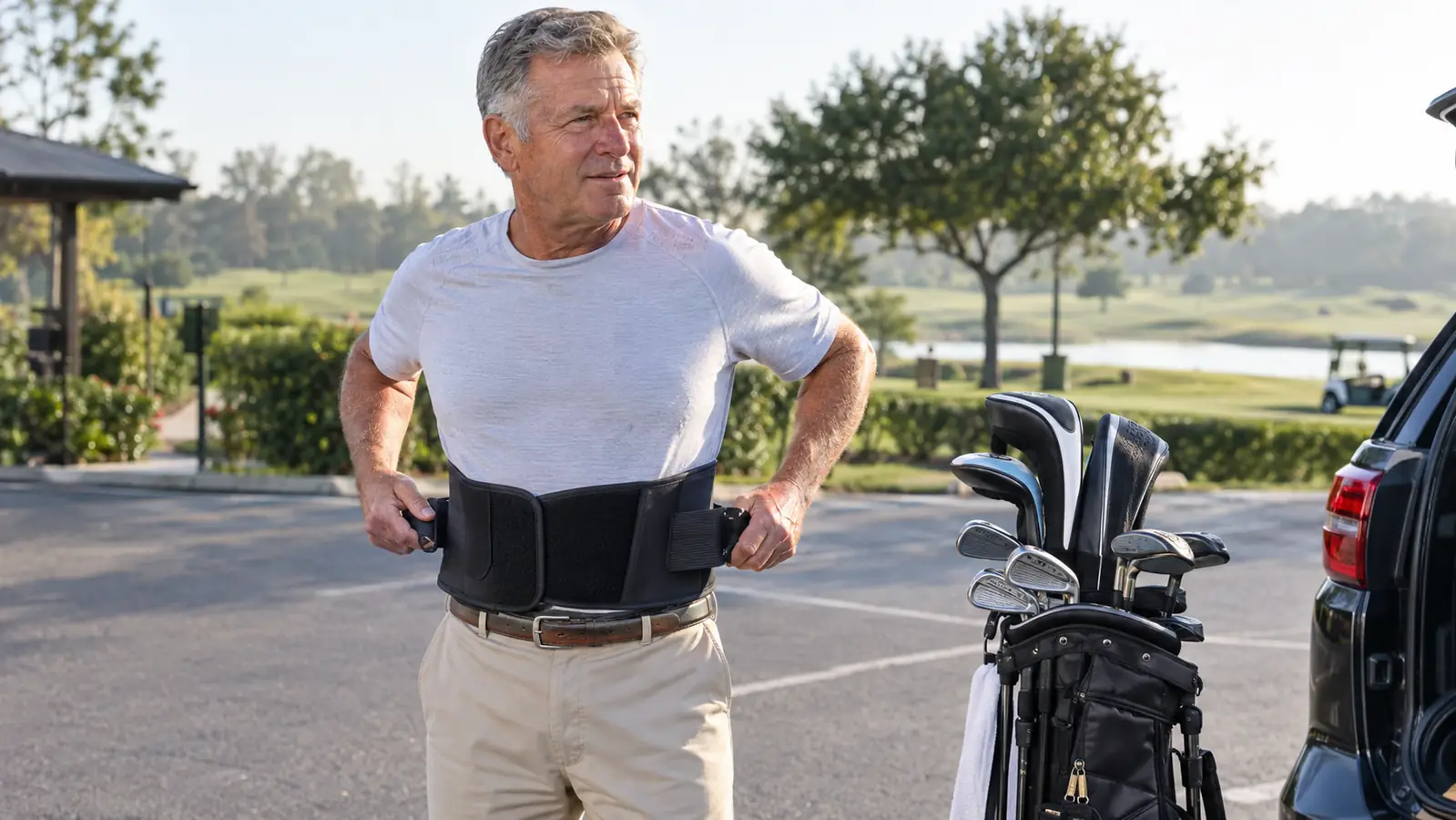
Step 2: Put the Sparthos brace on in the parking lot
I do not wear the Sparthos back brace every round. I wear it on cold mornings and on days my back is already stiff, which works out to about one round in three. I put it on in the parking lot, over a thin undershirt, before I walk to the pro shop. The padded panel sits against my lower back, the side straps pull snug but not tight, and the breathable mesh means I am not soaked by the third hole. I bought mine in May of last year, so I have had it for about seventeen months now, and it has held up through two summers and one full Ohio winter.
Here is what the brace actually does for me. It gives support, and it gives me a reminder. Every time I start to rush a swing or lurch at the ball, I feel the brace and I check myself. It does not fix anything and it does not make me pain-free. It just keeps my back from being the thing I am thinking about on every shot, and for a 16-handicap golfer, that is worth a lot. At first it felt like nothing more than a wide belt. By the third hole I understood: I was swinging without flinching, and that was new.
One honest note: the brace is not a substitute for warming up. I learned that the hard way last spring when I skipped my warm-up, strapped on the brace, and hit my first drive like a rusty gate. The brace helped me finish the round, but it did not make up for the twenty minutes I had skipped. Now the brace goes on after the warm-up, not instead of it. That is the order that works, and I have stopped trying to find a shortcut around it.
Step 3: Build your swing from the ground up
When my back is stiff, I do not try to hit the ball hard. I build the swing from the ground up, starting with my feet and working my way to the club. I set up with my weight a little more on my front foot, I take a shorter backswing, and I let my hips turn instead of forcing them. The ball does not go as far, but it goes straight, and straight is a lot more fun than long and into the trees. I would rather give up a stroke or two with a smooth swing than finish the front nine with a back that hurts.
I also use my Callaway Alignment Stix at the range on the evenings I practice. They are two bright yellow 48-inch sticks that collapse into short sections so they fit in the bag. I lay one along the target line at my toes and one along the ball line, and I hit easy seven-irons until my setup feels automatic. I have had them since April of last year, so this is my second season with them, and they live in my bag full time. When my back is the limiting factor, a simple setup and a smooth tempo beat a heroic swing every time.
The other thing I do is take the cart more often on stiff days. I usually walk when the weather allows, but if my back is already talking to me on the first tee, I ride. That is not giving up. That is saving my back for the shots that matter, and it is the difference between a good back nine and a miserable one. I have also learned to take one extra club on stiff days, because a smooth three-quarter swing with a longer club still gets me the distance I need.
Step 4: Move between shots, do not stand still
The worst thing for my back on the course is standing still. If I stand over a shot for too long, or sit in the cart for ten minutes and then try to hit, my back locks up. So I have a rule: I move between every shot. I take a few slow steps, I swing the club gently behind me, I roll my shoulders, and I only step up to the ball when I am ready to swing. I started doing this after a round last summer where I sat in the cart for fifteen minutes waiting on the group ahead, and then nearly could not get out of the cart.
This sounds like small stuff, but it is the difference between a round that feels good and a round that leaves me on the couch with a heating pad. My wife Carol is the one who first suggested I stop skipping my warm-up, and she is also the one who noticed I play better when I keep moving between shots. She does not golf, but she watches me come home, and she can tell the difference. On the days I follow my own rule, I walk through the back door looser, and on the days I do not, she does not even have to ask.
I also keep the Sparthos brace on for the whole round on the days I wear it. I used to take it off after the front nine, thinking I did not need it anymore. That was a mistake. The back nine is when I get tired and my form falls apart, and that is exactly when the brace earns its keep. Now it stays on until I am back in the parking lot, and I have stopped trying to outsmart it.
Step 5: Do the evening reset so tomorrow is not worse
What I do after a round matters as much as what I do before it. When I get home, I spend ten minutes on the living-room rug with the TriggerPoint foam roller, working on my upper back, glutes, hips and hamstrings. Then I sit in a chair with my feet flat, and I let my back settle before I try to do anything else. If I skip this, I pay for it the next morning. I have had the roller since January of last year, and it is the piece of gear I use most often, even on days I do not play.
I do not wear the Sparthos brace at night. It is a course tool, not a sleeping aid. I take it off in the parking lot, and the evening reset is about gentle movement, not about strapping myself into anything. The goal is to wake up tomorrow feeling like I could play again, because I play three times a week, and I would like to keep doing that for a long time. On Sunday afternoons I play pickleball with friends, and the same reset keeps me loose for that too.
If your back is genuinely hurting, please see a doctor or a physical therapist. That is what I did four years ago, and it is the reason I can still play at all. A brace, a roller and a swing trainer are tools, not treatments. They help me feel better and stay less stiff, but they did not diagnose anything and they do not cure anything. Real pain deserves real advice.
What Else Helps
The Sparthos brace is the piece people ask me about, but it is only one piece of the puzzle. The Orange Whip gets me loose before I leave the house. The Callaway Alignment Stix keep my setup honest at the range. The GoSports Elite hitting mat lets me practice in the garage all winter. And the TriggerPoint foam roller is what I use to reset after a round. Together, they are the difference between a hobby that hurts and a hobby I can keep playing.
If I had to pick just one thing to add to your routine, it would be the warm-up. The brace is great on stiff mornings, but the warm-up is what keeps me from needing the brace as often. Start there, add the brace for the days your back is already talking to you, and let the rest of the gear fill in the gaps. That is the system that works for me, and I hope it helps you stay on the course too.
The brace does not fix anything. It just keeps my back from being the thing I am thinking about on every shot, and for a 16-handicap golfer, that is worth a lot.
Give your back the same support I use
The Sparthos back brace has been in my bag for over a year, and it is the first thing I reach for on a stiff morning. It is not a cure, but it is honest support that lets me swing without thinking about my back. If you are tired of letting a stiff back decide whether you play, this is a good place to start.
Amazon Check Today's Price on Amazon →